


Makkah Al Mukarramah
The Centre Of The Earth Is Located In Makka, The Holy City Of Muslims And Birth Place Of Rasoolallah Sallallahu Alaihe Wasallam

Jali Mubarak Of Rasoolallah Sallallahu alaihe wasallam
The blessed house of Rasoolallah and also the resting place of Rasoolallah Sallallahu alaihe wasallam, Hazrat Abu Bakr Siddeeq Radiallahu anh and Hazrat Umar radiallahu anh

Shab-e-Bara'at | Rahmat-o-Maghfirat ki Raat [URDU]
 Ahmed
Ahmed
ماہِ شعبان کی پندرہویں رات کو شبِ برأت کہا جاتا ہے شب کے معنی ہیں رات اور برأت کے معنی بری ہونے اور قطع تعلق کرنے کے ہیں ۔ چونکہ اس رات مسلمان توبہ کرکے گناہوں سے قطع تعلق کرتے ہیں اور اللہ تعالیٰ کی رحمت سے بے شمار مسلمان جہنم سے نجات پاتے ہیں اس لیے اس رات کو شبِ برأت کہتے ہیں ۔ اس رات کو لیلۃ المبارکۃ یعنی برکتوں والی رات، لیلۃ الصک یعنی تقسیم امور کی رات اور لیلۃ الرحمۃ یعنی رحمت نازل ہونے کی رات بھی کہا جاتا ہے۔
جلیل القدر تابعی حضرت عطاء بن یسار رضی اللہ تعالیٰ عنہ، فرماتے ہیں،
جس طرح مسلمانوں کے لیے زمین میں دو عیدیں ہیں اس یطرح فرشتوں کے آسمان میں دو عیدیں ہیں ایک شبِ برأت اور دوسری شبِ قدر جس طرح مومنوں کی عیدیں عید الفطر اور عید الاضحٰی ہین فرشتوں کی عیدیں رات کو اس لیے ہیں کہ وہ رات کو سوتے نہیں جب کہ آدمی رات کو سوتے ہیں اس لیے ان کی عیدیں دن کو ہیں ۔(غنیۃ الطالبین ص ٤٤٩)
ارشاد باری تعالیٰ ہوا، ''قسم ہے اس روشن کتاب کی بے شک ہم نے اسے برکت والی رات میں اتارا، بے شک ہم ڈر سنانے والے ہیں اس میں بانٹ دیا جاتا ہے ہر حکمت والا کام''۔ (الدخان ٢ تا ٤ ، کنزالایمان)
علامہ قرطبی مالکی رحمتہ اللہ علیہ فرماتے ہیں
یہاں ایک شبہ یہ پیدا ہوتا ہے کہ یہ امور تو پہلے ہی سے لوح محفوظ میں تحریر ہیں پھر اس شب میں ان کے لکھے جانے کا کیا مطلب ہے؟ جواب یہ ہے کہ یہ امور بلاشبہ لوح محفوظ مین تحریر ہیں لیکن اس شب میں مذکورہ امور کی فہرست لوح محفوظ سے نقل کرکے ان فرشتوں کے سپرد کی جاتی ہے جن کے ذمہ یہ امور ہیں ۔
حضرتِ عائشہ صدیقہ رضی اللہ تعالیٰ عنہا فرماتی ہیں
حضرت عطاء بن یسار رضی اللہ تعالیٰ عنہ، فرماتے ہیں،
حضرت عثمان بن محمد رضی اللہ تعالیٰ عنہ سے مروی ہے کہ
چونکہ یہ رات گذشتہ سال کے تمام اعمال بارگاہِ الہٰی میں پیش ہونے اور آئندہ سال ملنے والی زندگی اور رزق وغیرہ کے حساب کتاب کی رات ہے اس لیے اس رات میں عبادت الہٰی میں مشغول رہنا رب کریم کی رحمتوں کے مستحق ہونے کا باعث ہے اور سرکار دو عالم صلی اللہ علیہ وآلہ وسلم کی یہی تعلیم ہے۔
شبِ برأت کی ایک بڑی خصوصیت یہ ہے کہ اس شب میں اللہ تعالیٰ اپنے فضل و کرم سے بے شمار لوگوں کی بخشش فرما دیتا ہے اسی حوالے سے چند احادیث مبارکہ ملاحظہ فرمائیں ۔
(١) حضرت عائشہ صدیقہ رضی اللہ تعالیٰ عنہا فرماتی ہیں،
شارحین فرماتے ہیں کہ یہ حدیث پاک اتنی زیادہ اسناد سے مروی ہے کہ درجہ صحت کو پہنچ گئی۔
(٢) حضرتِ ابو بکر صدیق رضی اللہ تعالیٰ عنہ، سے روایت ہے کہ آقا و مولیٰ صلی اللہ علیہ وآلہ وسلم نے فرمایا،
(٣) حضرت ابو موسیٰ اشعری رضی اللہ تعالیٰ عنہ، سے مروی ہے کہ
(٤) حضرت ابوہریرہ ، حضرت معاذ بن جبل، حضرت ابو ثعلیۃ اور حضرت عوف بن مالک رضی اللہ تعالیٰ عنہم سے بھی ایسا ہی مضمون مروی ہے۔ (مجمع الزوائد ج ٨ ص ٦٥)
(٥) حضرت عبد اللہ بن عمرو بن عاص رضی اللہ تعالیٰ عنہما سے روایت ہے کہ
(٦) امام بیہقی نے شعب الایمان (ج ٣ ص ٣٨٤) میں حضرت عائشہ رضی اللہ تعالیٰ عنہا کی ایک طویل روایت بیان کی ہے جس میں مغفرت سے محروم رہنے والوں میں ان لوگوں کا بھی ذکر رشتے ناتے توڑنے والا، بطور تکبر ازار ٹخنوں سے نیچے رکھنے والا، ماں باپ کا نافرمان، شراب نوشی کرنے والے۔
(٧) غنیۃ الطالبین ص ٤٤٩ پر حضرت ابو ہریرہ رضی اللہ تعالیٰ عنہ، سے مروی طویل حدیچ میں مزید ان لوگوں کا بھی ذکر ہے جادوگر، کاہن، سود خور اور بد کار، یہ وہ لوگ ہیں کہ اپنے اپنے گناہوں سے توبہ کیے بغیر ان کی مغفرت نہیں ہوتی۔ پس ایسے لوگوں کو چاہیے کہ اپنے اپنے گناہوں سے جلد از جلد سچی توبہ کرلیں تاکہ یہ بھی شب برأت کی رحمتوں اور بخشش و مغفرت کے حقدار ہوجائیں۔
ارشاد باری تعالیٰ ہوا ''اے ایمان والو اللہ کی طرف ایسی توبہ کرو جو آگے نصیحت ہوجائے''۔ (التحریم ٨ ، کنزالایمان)
یعنی توبہ ایسی ہونی چاہیے جس کا اثر توبہ کرنے والے کے اعمال میں ظاہر ہو اور اس کی زندگی گناہوں سے پاک اور عبادتوں سے معمور ہوجائے۔
حضرت معاذ بن جبل رضی اللہ تعالیٰ عنہ، نے بارگاہ رسالت صلی اللہ علیہ وآلہ وسلم میں عرض کی۔ یارسول اللہ صلی اللہ علیہ وآلہ وسلم توبۃ النصوح کسے کہتے ہیں اشاد ہوا بندہ اپنے گناہ پر سخت نادم اور شرمدسار ہو۔ پھر بارگاہ الہٰی میں گڑگڑا کر مغفرت مانگے۔ اور گناہوں سے بچنے کا پختہ عزم کرے تو جس طرح دودھ دوبارہ تھنوں میں داخل نہیں ہوسکتا اسی طرح اس بندے سے یہ گناہ کبھی سرزد نہ ہوگا۔
شبِ برأت فرشتوں کو بعض امور دئیے جانے اور مسلمانوں کی مغفرت کی رات ہے اس کی ایک او ر خصوصیت یہ ہے کہ یہ رب کریم کی رحمتوں کے نزول کی اور دعاؤں کے قبول ہونے کی رات ہے۔
١۔ حضرت عثمان بن ابی العاص رضی اللہ تعالیٰ عنہ، سے روایت ہے کہ
٢۔ حضرت علی رضی اللہ تعالیٰ عنہ، سے روایت ہے کہ غیب بتانے والے آقا و مولیٰ صلی اللہ علیہ وآلہ وسلم نے فرمایا
اس حدیث پاک میں اللہ تعالیٰ کی طرف سے مغفرت و رحمت کی ندا کا ذکر ہے اگرچہ یہ ندا ہر رات میں ہوتی ہے لیکن رات کے آخری حصے میں جیسا کہ کتاب کے آغاز میں شبِ بیداری کی فضیلت کو عنوان کے تحت حدیث پاک تحریر کی گئی شبِ برأت ی خاص بات یہ ہے کہ اس میں یہ ندا غروب آفتاب ہی سے شروع ہوجاتی ہے گویا صالحین اور شبِ بیدار مومنوں کے لیے تو ہر رات شبِ برأت ہے مگر یہ رات خطاکاروں کے لیے رحمت و عطا اور بخشش و مغفرت کی رات ہے اس لیے ہمیں شاہیے کہ اس رات میں اپنے گناہوں پر ندامت کے آنسو بہائیں اور ربِ کریم سے دنیا و آخرت کی بھلائی مانگیں ۔ اس شب رحمتِ خداوندی ہر پیاسے کو سیراب کردینا چاہتی ہے اور ہر منگتے کی جھولی گوہرِ مراد سے بھر دینے پر مائل ہوتی ہے۔ بقول اقبال، رحمت الہٰی یہ ندا کرتی ہے
شبِ برأت میں سرکار دو عالم صلی اللہ علیہ وآلہ وسلم نے خود بھی شبِ بیداری کی اور دوسروں کو بھی شبِ بیداری کی تلقین فرمائی آپ صلی اللہ علیہ وآلہ وسلم کا فرمان عالیشان اوپر مذکور ہوا کہ "جب شعبان کی پندرہویں رات ہو تو شبِ بیداری کرو اور دن کو روزہ رکھو'' اس فرمان جلیل کی تعمیل میں اکابر علمائے اہلسسنت اور عوام اہلسنت کا ہمیشہ سے یہ معمول رہا ہے کہ رات میں شبِ بیداری کا اہتمام کرتے چلے آئے ہیں۔
شیخ عبد الحق محدث دہلوی رحمتہ اللہ علیہ فرماتے ہیں،
علامہ ابنِ الحاج مانکی رحمتہ اللہ علیہ شبِ برأت کے متعلق رقم طراز ہیں
مذکورہ بالا حوالوں سے یہ بات ثابت ہوئی کہ اس مقد رات مین مسجد مین جمع ہوکر عبادات میں مشغول رہانا اور اس رات شبِ بیداری کا اہتمام کرنا تابعین کرام کا طریقہ رہا ہے۔
شیخ عبد الحق محدث دہلوی قدس سرہ فرماتے ہیں،
آقا و مولیٰ صلی اللہ علیہ وآلہ وسلم نے زیارت قبور کی ایک بڑی حکمت یہ بیان فرمائی ہے کہ اس رات موت یاد آتی ہے۔ اور آخرت کی فکر پیدا ہوتی ہے۔ شبِ برأت میں زیارتِ قبور کا واضح مقصد یہی ہے کہ اس مبارک شب میں ہم اپنی موت کو یاد کریں تاکہ گناہوں سے سچی توبہ کرنے میں آسانی ہو۔ یہی شبِ بیداری کا اصل مقصد ہے۔
اس سلسلے میں حضرت حسن بصری رضی اللہ تعالیٰ عنہ، کا ایمان افروز واقعہ بھی ملاحظہ فرمائیں منقول ہے کہ
اللہ اکبر نیک و متقی لوگوں کا یہ حال ہے جو ہر رات شبِ بیداری کرتے ہیں اور تمام دن اطاعتِ الہٰی میں گزارتے ہیں جب کہ اس کے برعکس کچھ لوگ ایسے کم نصیب ہیں جو اس مقدس رات میں فکر آخرت اور عبادت و دعا میں مشغول ہونے کی بجائے مزید لہو و لعب میں مبتلا ہوجاتے ہیں آتش بازی پٹاخے اور دیگر ناجائز امور میں مبتلا ہوکر وی اس مبارک رات کا تقد س پامال کرتے ہیں ۔ حالانکہ آتش بازی اور پٹاخے نہ صرف ان لوگوں اور ان کے بچوں کی جان کے لیے خطرہ ہیں بلکہ ارد گرد کے لوگوں کی جان کے لیے بھی خطرتے کا باعث بنتے ہیں ۔ ایسے لوگ ''مال برباد اور گناہ لازم'' کا مصداق ہیں ۔
ہمیں چاہیے کہ ایسے گناہ کے کاموں سے خود بھی بچیں اور دوسروں کو بھی بچائیں اور بچوں کو سمجھائیں کہ ایسے لغو کاموں سے اللہ تعالیٰ اور اس کے پیارے حبیب صلی اللہ علیہ وآلہ وسلم ناراض ہوتے ہیں ۔ مجدد برحق اعلیٰ ھضرت امام احمد رضا محدث بریلوی رحمتہ اللہ علیہ فرماتے ہیں ۔ آتش بازی جس طرح شادیوں اور شب برأت میں رائج ہے بے شک حرام اور پورا جرم ہے کہ اس میں مال کا ضیاع ہے۔ قرآن مجید میں ایسے لوگوں کو شیطان کے بھائی فرمایا گیا۔ ارشاد ہوا،
نبی کریم صلی اللہ علیہ وآلہ وسلم کا ارشادِ گرامی ہے،
یہ حدیث پہلے مذکورہ ہو چکی کہ مرنے والوں کے ناموں کی فہرست پندرہویں شعبان کی رات کو تیار کی جاتی ہے۔ حضور صلی اللہ علیہ وآلہ وسلم کے اس ارشاد سے معلوم ہوا کہ اگرچہ رات کے وقت روزہ نہیں ہوتا اس کے باوجود روزہ دار لکھے جانے کا مطلب یہ ہے کہ بوقت کتاب (شب) اللہ تعالیٰ روزی کی برکت کو جاری رکھتا ہے۔ (ماثبت من السنہ ١٩٢)
حضرت عائشہ صدیقہ رضی اللہ تعالیٰ عنہا فرماتی ہیں کہ،
ایک اور روایت میں فرمایا،
جلیل القدر تابعی حضرت عطاء بن یسار رضی اللہ تعالیٰ عنہ، فرماتے ہیں،
''لیلۃ القدر کے بعد شعبان کی پندرھویں شب سے افضل کوئی رات نہیں''۔ (لطائف المعارف ص ١٤٥)
جس طرح مسلمانوں کے لیے زمین میں دو عیدیں ہیں اس یطرح فرشتوں کے آسمان میں دو عیدیں ہیں ایک شبِ برأت اور دوسری شبِ قدر جس طرح مومنوں کی عیدیں عید الفطر اور عید الاضحٰی ہین فرشتوں کی عیدیں رات کو اس لیے ہیں کہ وہ رات کو سوتے نہیں جب کہ آدمی رات کو سوتے ہیں اس لیے ان کی عیدیں دن کو ہیں ۔(غنیۃ الطالبین ص ٤٤٩)
تقسیمِ امور کی رات
ارشاد باری تعالیٰ ہوا، ''قسم ہے اس روشن کتاب کی بے شک ہم نے اسے برکت والی رات میں اتارا، بے شک ہم ڈر سنانے والے ہیں اس میں بانٹ دیا جاتا ہے ہر حکمت والا کام''۔ (الدخان ٢ تا ٤ ، کنزالایمان)
''اس رات سے مراد شبِ قدر ہے یا شبِ برأت'' (خزائن العرفان) ان آیات کی تفسیر میں حضرتِ عکرمہ رضی اللہ تعالیٰ عنہ، اور بعض دیگر مفسرین نے بیان کیا ہے کہ ''لیلۃ مبارکۃ'' سے پندرہ شعبان کی رات مراد ہے ۔ اس رات میں زندہ رہنے والے ، فوت ہونے والے اور حج کرنے والے سب کے ناموں کی فہرست تیار کی جاتی ہے اور جس کی تعمیل میں ذرا بھی کمی بیشہ نہیں ہوتی ۔ اس روایت کو ابن جریر، ابن منذر اور ابنِ ابی حاتم نے بھی لکھا ہے۔ اکثر علماء کی رائے یہ ہے کہ مذکورہ فہرست کی تیاری کا کام لیلۃ القدر مین مکمل ہوتا ہے۔ اگرچہ اس کی ابتداء پندرہویں شعبان کی شب سے ہوتی ہے۔ (ماثبت من السنہ ص ١٩٤)
علامہ قرطبی مالکی رحمتہ اللہ علیہ فرماتے ہیں
ایک قول یہ ہے کہ ان امور کے لوحِ محفوظ سے نقل کرنے کا آغاز شبِ برأت سے ہوتا ہے اور اختتام لیلۃ القدر میں ہوتا ہے۔ (الجامع الاحکام القرآن ج ١٦ ص ١٢٨)
یہاں ایک شبہ یہ پیدا ہوتا ہے کہ یہ امور تو پہلے ہی سے لوح محفوظ میں تحریر ہیں پھر اس شب میں ان کے لکھے جانے کا کیا مطلب ہے؟ جواب یہ ہے کہ یہ امور بلاشبہ لوح محفوظ مین تحریر ہیں لیکن اس شب میں مذکورہ امور کی فہرست لوح محفوظ سے نقل کرکے ان فرشتوں کے سپرد کی جاتی ہے جن کے ذمہ یہ امور ہیں ۔
حضرتِ عائشہ صدیقہ رضی اللہ تعالیٰ عنہا فرماتی ہیں
رسول کریم صلی اللہ علیہ وآلہ وسلم نے فرمایا کیا تم جانتی ہو کہ شعبان کی پندرہویں شب میں کیا ہوتا ہے؟ میں نے عرض کی یا رسول اللہ صلی اللہ علیہ وآلہ وسلم آپ فرمائیے۔ ارشاد ہوا آئندہ سال مین جتنے بھی پیدا ہونے والے ہوتے ہیں وہ سب اس شب میں لکھ دئیے جاتے ہیں اور جتنے لوگ آئندہ سال مرنے والے ہوتے ہیں وہ بھی اس رات مین لکھ دئیے جاتے ہیں اور اس رات میں لوگوں کا مقررہ رزق اتارا جاتاہے۔ (مشکوٰۃ جلد ١ ص ٢٧٧)
حضرت عطاء بن یسار رضی اللہ تعالیٰ عنہ، فرماتے ہیں،
''شعبان کی پندرہویں رات میں اللہ تعالیٰ ملک الموت کو ایک فہرست دے کر حکم فرماتا ہے کہ جن جن لوگوں کے نام اس میں لکھے ہیں ان کی روحوں کو آئندہ سال مقررہ وقتوں پر قبض کرنا۔ تو اس شب میں لوگوں کے حالات یہ ہوتے ہیں کہ کوئی باغوں میں درخت لگانے کی فکر میں ہوتا ہے کوئی شادی کی تیاریوں میں مصروف ہوتا ہے۔ کوئی کوٹھی بنگلہ بنوا رہا ہوتا ہے حالانکہ ان کے نام مُردوں کی فہرست میں لکھے جاچکے ہوتے ہیں ۔ (مصنف عبد الرزاق جلد ٤ ص ٣١٧ ، ماثبت من السنہ ص ١٩٣)
حضرت عثمان بن محمد رضی اللہ تعالیٰ عنہ سے مروی ہے کہ
سرکار مدینہ صلی اللہ علیہ وآلہ وسلم نے فرمایا ایک شعبان سے دوسرے شعبان تک لوگوں کی زندگی منقطع کرنے کا وقت اس رات میں لکھا جاتا ہے یہاں تک کہ انسان شادی بیاہ کرتا ہے اور اس کے بچے پیدا ہوتے ہیں حالانکہ اس کا نام مُردوں کی فہرست میں لکھا جاچکا ہوتا ہے۔ (الجامع الاحکام القرآن ج ١٦ ص ١٢٦، شعب الایمان للبیہقی ج ٣ ص ٣٨٦)
چونکہ یہ رات گذشتہ سال کے تمام اعمال بارگاہِ الہٰی میں پیش ہونے اور آئندہ سال ملنے والی زندگی اور رزق وغیرہ کے حساب کتاب کی رات ہے اس لیے اس رات میں عبادت الہٰی میں مشغول رہنا رب کریم کی رحمتوں کے مستحق ہونے کا باعث ہے اور سرکار دو عالم صلی اللہ علیہ وآلہ وسلم کی یہی تعلیم ہے۔
مغفرت کی رات
شبِ برأت کی ایک بڑی خصوصیت یہ ہے کہ اس شب میں اللہ تعالیٰ اپنے فضل و کرم سے بے شمار لوگوں کی بخشش فرما دیتا ہے اسی حوالے سے چند احادیث مبارکہ ملاحظہ فرمائیں ۔
(١) حضرت عائشہ صدیقہ رضی اللہ تعالیٰ عنہا فرماتی ہیں،
ایک رات میں نے حضور اکرم صلی اللہ علیہ وآلہ وسلم کو اپنے پاس نہ پایا تو میں آپ صلی اللہ علیہ وآلہ وسلم کی تلاش میں نکلی میں نے دیکھا کہ آپ صلی اللہ علیہ وآلہ وسلم جنت البقیع میں تشریف فرما ہیں آپ صلی اللہ علیہ وآلہ وسلم نے فرمایا کیا تمہیں یہ خوف ہے کہ اللہ تعالیٰ اور اس کے رسول صلی اللہ علیہ وآلہ وسلم تمہارے ساتھ زیادتی کریں گے۔ میں نے عرض کی یا رسول اللہ صلی اللہ علیہ وآلہ وسلم مجھے یہ خیال ہوا کہ شاید آپ صلی اللہ علیہ وآلہ وسلم کسی دوسری اہلیہ کے پاس تشریف لے گئے ہیں آقا و مولیٰ صلی اللہ علیہ وآلہ وسلم نے فرمایا بیشک اللہ تعالیٰ شعبان کی پندرہویں شب آسمانِ دنیا پر (اپنی شان کے مطابق) جلوہ گر ہوتا ہے اور قبیلہ بنو کلب کی بکریوں کے بالوں سے زیادہ لوگوں کی مغفرت فرماتا ہے۔ (ترمذی جلد ١ ص ١٥٦، ابن ماجہ ص ١٠٠، مسند احمد جلد ٦ ص ٢٣٨، مشکوٰۃ جلد ١ ص ٢٧٧، مصنف ابنِ ابی شعبہ ج ١ ص ٣٣٧، شعب الایمان للبیہقی جلد ٣ ص ٣٧٩)
شارحین فرماتے ہیں کہ یہ حدیث پاک اتنی زیادہ اسناد سے مروی ہے کہ درجہ صحت کو پہنچ گئی۔
(٢) حضرتِ ابو بکر صدیق رضی اللہ تعالیٰ عنہ، سے روایت ہے کہ آقا و مولیٰ صلی اللہ علیہ وآلہ وسلم نے فرمایا،
''شعبان کی پندرہویں شب میں اللہ تعالیٰ آسمانِ دنیا پر (اپنی شان کے مطابق) جلوہ گر ہوتا ہے اور اس شب میں ہر کسی کی مغفرت فرما دیتا ہے سوائے مشرک اور بغض رکھنے والے کے''۔ (شعب الایمان للبیہقی جلد ٣ ص ٣٨٠)
(٣) حضرت ابو موسیٰ اشعری رضی اللہ تعالیٰ عنہ، سے مروی ہے کہ
نبی کریم صلی اللہ علیہ وآلہ وسلم کا ارشاد ہے اللہ تعالیٰ شعبان کی پندرہویں شب مین اپنے رحم و کرم سے تمام مخلوق کو بخش دیتا ہے سوائے مشرک اور کینہ رکھنے والے کے''۔ (ابنِ ماجہ ص ١٠١، شعب الایمان ج ٣ ص ٣٨٢، مشکوٰۃ جلد ١ ص ٢٧٧)
(٤) حضرت ابوہریرہ ، حضرت معاذ بن جبل، حضرت ابو ثعلیۃ اور حضرت عوف بن مالک رضی اللہ تعالیٰ عنہم سے بھی ایسا ہی مضمون مروی ہے۔ (مجمع الزوائد ج ٨ ص ٦٥)
(٥) حضرت عبد اللہ بن عمرو بن عاص رضی اللہ تعالیٰ عنہما سے روایت ہے کہ
آقا و مولیٰ صلی اللہ علیہ وآلہ وسلم نے فرمایا، ''شعبان کی پندرہویں رات میں اللہ تعالیٰ اپنی رحمت سے دو شخصوں کے سوا سب مسلمانوں کی مغفرت فرمادیتا ہے ایک کینہ پرور اور دوسرا کسی کو ناحق قتل کرنے والا''۔ (مسند احمد ج ٢ ص ١٧٦، مشکوٰۃ جلد ١ ص ٢٧٨)
(٦) امام بیہقی نے شعب الایمان (ج ٣ ص ٣٨٤) میں حضرت عائشہ رضی اللہ تعالیٰ عنہا کی ایک طویل روایت بیان کی ہے جس میں مغفرت سے محروم رہنے والوں میں ان لوگوں کا بھی ذکر رشتے ناتے توڑنے والا، بطور تکبر ازار ٹخنوں سے نیچے رکھنے والا، ماں باپ کا نافرمان، شراب نوشی کرنے والے۔
(٧) غنیۃ الطالبین ص ٤٤٩ پر حضرت ابو ہریرہ رضی اللہ تعالیٰ عنہ، سے مروی طویل حدیچ میں مزید ان لوگوں کا بھی ذکر ہے جادوگر، کاہن، سود خور اور بد کار، یہ وہ لوگ ہیں کہ اپنے اپنے گناہوں سے توبہ کیے بغیر ان کی مغفرت نہیں ہوتی۔ پس ایسے لوگوں کو چاہیے کہ اپنے اپنے گناہوں سے جلد از جلد سچی توبہ کرلیں تاکہ یہ بھی شب برأت کی رحمتوں اور بخشش و مغفرت کے حقدار ہوجائیں۔
ارشاد باری تعالیٰ ہوا ''اے ایمان والو اللہ کی طرف ایسی توبہ کرو جو آگے نصیحت ہوجائے''۔ (التحریم ٨ ، کنزالایمان)
یعنی توبہ ایسی ہونی چاہیے جس کا اثر توبہ کرنے والے کے اعمال میں ظاہر ہو اور اس کی زندگی گناہوں سے پاک اور عبادتوں سے معمور ہوجائے۔
حضرت معاذ بن جبل رضی اللہ تعالیٰ عنہ، نے بارگاہ رسالت صلی اللہ علیہ وآلہ وسلم میں عرض کی۔ یارسول اللہ صلی اللہ علیہ وآلہ وسلم توبۃ النصوح کسے کہتے ہیں اشاد ہوا بندہ اپنے گناہ پر سخت نادم اور شرمدسار ہو۔ پھر بارگاہ الہٰی میں گڑگڑا کر مغفرت مانگے۔ اور گناہوں سے بچنے کا پختہ عزم کرے تو جس طرح دودھ دوبارہ تھنوں میں داخل نہیں ہوسکتا اسی طرح اس بندے سے یہ گناہ کبھی سرزد نہ ہوگا۔
رحمت کی رات
شبِ برأت فرشتوں کو بعض امور دئیے جانے اور مسلمانوں کی مغفرت کی رات ہے اس کی ایک او ر خصوصیت یہ ہے کہ یہ رب کریم کی رحمتوں کے نزول کی اور دعاؤں کے قبول ہونے کی رات ہے۔
١۔ حضرت عثمان بن ابی العاص رضی اللہ تعالیٰ عنہ، سے روایت ہے کہ
حضور اکرم صلی اللہ علیہ وآلہ وسلم کا ارشاد ہے۔ ''جب شعبان کی پندرہویں شب آتی ہے تو اللہ تعالیٰ کی طرف سے اعلان ہوتا ہے، ہے کوئی مغفرت کا طالب کہ اس کے گناہ بخش دوں ، ہے کوئی مجھ سے مانگنے والا کہ اسے عطا کروں ۔ اس وقت اللہ تعالیٰ سے جو مانگا جائے وہ ملتا ہے۔ وہ سب کی دعا قبول فرماتا ہے سوائے بدکار عورت اور مشرک کے''۔ (شعب الایمان للبیہقی ج٣ ص ٣٨٣)
٢۔ حضرت علی رضی اللہ تعالیٰ عنہ، سے روایت ہے کہ غیب بتانے والے آقا و مولیٰ صلی اللہ علیہ وآلہ وسلم نے فرمایا
جب شعبان کی پندرھویں شب ہو تورات کو قیام کرو اور دن کو روزہ رکھو کیونکہ غروب آفتاب کے وقت سے ہی اللہ تعالیٰ کی رحمت آسمان دنیا پر نازل ہوجاتی ہے اور اللہ تعالیٰ ارشاد فرماتا ہے، ہے کوئی مغفرت کا طلب کرنے والا کہ میں اسے بخش دوں ۔ ہے کوئی رزق مانگنے والا کہ میں اس کو رزق دوں ہے کوئی مصیبت زدہ کہ میں اسے مصیبت سے نجات دوں ، یہ اعلان طلوع فجر تک ہوتا رہتا ہے۔ (ابنِ ماجہ ص ١٠٠، شعب الایمان للبیہقی ج ٣ ص ٣٧٨، مشکوٰۃ ج ١ ص ٢٧٨)
اس حدیث پاک میں اللہ تعالیٰ کی طرف سے مغفرت و رحمت کی ندا کا ذکر ہے اگرچہ یہ ندا ہر رات میں ہوتی ہے لیکن رات کے آخری حصے میں جیسا کہ کتاب کے آغاز میں شبِ بیداری کی فضیلت کو عنوان کے تحت حدیث پاک تحریر کی گئی شبِ برأت ی خاص بات یہ ہے کہ اس میں یہ ندا غروب آفتاب ہی سے شروع ہوجاتی ہے گویا صالحین اور شبِ بیدار مومنوں کے لیے تو ہر رات شبِ برأت ہے مگر یہ رات خطاکاروں کے لیے رحمت و عطا اور بخشش و مغفرت کی رات ہے اس لیے ہمیں شاہیے کہ اس رات میں اپنے گناہوں پر ندامت کے آنسو بہائیں اور ربِ کریم سے دنیا و آخرت کی بھلائی مانگیں ۔ اس شب رحمتِ خداوندی ہر پیاسے کو سیراب کردینا چاہتی ہے اور ہر منگتے کی جھولی گوہرِ مراد سے بھر دینے پر مائل ہوتی ہے۔ بقول اقبال، رحمت الہٰی یہ ندا کرتی ہے
ہم تو مائل بہ کرم ہیں کوئی سائل ہی نہیں ۔۔۔ راہ دکھلائیں کسے راہرو منزل ہی نہیں
شبِ بیداری کا اہتمام
شبِ برأت میں سرکار دو عالم صلی اللہ علیہ وآلہ وسلم نے خود بھی شبِ بیداری کی اور دوسروں کو بھی شبِ بیداری کی تلقین فرمائی آپ صلی اللہ علیہ وآلہ وسلم کا فرمان عالیشان اوپر مذکور ہوا کہ "جب شعبان کی پندرہویں رات ہو تو شبِ بیداری کرو اور دن کو روزہ رکھو'' اس فرمان جلیل کی تعمیل میں اکابر علمائے اہلسسنت اور عوام اہلسنت کا ہمیشہ سے یہ معمول رہا ہے کہ رات میں شبِ بیداری کا اہتمام کرتے چلے آئے ہیں۔
شیخ عبد الحق محدث دہلوی رحمتہ اللہ علیہ فرماتے ہیں،
''تابعین میں سے جلیل القدر حضرات مثلاً حضرت خالد بن معدان، حضرت مکحول، حضرت لقمان بن عامر اور حضرت اسحٰق بن راہویہ رضی اللہ تعالیٰ عنہم مسجد میں جمع ہو کر شعبان کی پندرہویں شب میں شبِ بیداری کرتے تھے اور رات بھر مسجد میں عبادات میں مصروف رہتے تھے''۔ (ما ثبت من السنہ ٢٠٢، لطائف المعارف ص ١٤٤)
علامہ ابنِ الحاج مانکی رحمتہ اللہ علیہ شبِ برأت کے متعلق رقم طراز ہیں
''اور کوئی شک نہیں کہ یہ رات بڑی بابرکت اور اللہ تعالیٰ کے نزدیک بڑی عظمت والی ہے۔ ہمارے اسلاف رضی اللہ تعالیٰ عنہیم اس کی بہت تعظیم کرتے اور اس کے آنے سے قبل اس کے لیے تیاری کرتے تھے۔ پھر جب یہ رات آتی تو وہ جوش و جذبہ سے اس کا استقبال کرتے اور مستعدی کے ساتھ اس رات میں عبادت کیا کرتے تھے کیونکہ یہ بات ثابت ہوچکی ہے کہ ہمارے اسلاف شعائر اللہ کا بہت احترام کیا کرتے تھے۔" (المدخل ج ١ ص ٣٩٢)
مذکورہ بالا حوالوں سے یہ بات ثابت ہوئی کہ اس مقد رات مین مسجد مین جمع ہوکر عبادات میں مشغول رہانا اور اس رات شبِ بیداری کا اہتمام کرنا تابعین کرام کا طریقہ رہا ہے۔
شیخ عبد الحق محدث دہلوی قدس سرہ فرماتے ہیں،
''اب جو شخص شعبان کی پندرہویں رات مین شبِ بیداری کرے تو یہ فعل احادیث کی مطابقت میں بالکل مستحب ہے۔ رسول کریم صلی اللہ علیہ وآلہ وسلم کا یہ عمل بھی احادیث سے ثابت ہے کہ شبِ برأت میں آپ صلی اللہ علیہ وآلہ وسلم مسلمانوں کی دعائے مغفرت کے لیے قبرستان تشریف لے گئے تھے۔" (ماثبت من السنہ ص ٢٠٥)
آقا و مولیٰ صلی اللہ علیہ وآلہ وسلم نے زیارت قبور کی ایک بڑی حکمت یہ بیان فرمائی ہے کہ اس رات موت یاد آتی ہے۔ اور آخرت کی فکر پیدا ہوتی ہے۔ شبِ برأت میں زیارتِ قبور کا واضح مقصد یہی ہے کہ اس مبارک شب میں ہم اپنی موت کو یاد کریں تاکہ گناہوں سے سچی توبہ کرنے میں آسانی ہو۔ یہی شبِ بیداری کا اصل مقصد ہے۔
اس سلسلے میں حضرت حسن بصری رضی اللہ تعالیٰ عنہ، کا ایمان افروز واقعہ بھی ملاحظہ فرمائیں منقول ہے کہ
جب آپ رضی اللہ تعالیٰ عنہ، شبِ برأت میں گھر سے باہر تشریف لائے تو آپ کا چہرہ یوں دکھائی دیتا تھا جس طرح کسی کوقبر میں دفن کرنے کے بعد باہر نکالا گیا ہو۔ آپ سے اس کا سبب پوچھا گیا تو آپ رضی اللہ تعالیٰ عنہ، نے فرمایا خدا کی قسم میری مثال ایسی ہے جیسے کسی کی کشتی سمند میں ٹوٹ چکی ہو اور وہ ڈوب رہا ہو اور بچنے کی کوئی امید نہہو۔ پوچھا گیا آپ رضی اللہ تعالیٰ عنہ، کی ایسی حالت کیوں ہے؟ فرمایا میرے گناہ یقینی ہیں ۔ لیکن اپنی نیکیوں کے متعلق میں نہیں جانتا کہ وہ مجھ سے قبول کی جائیں گی یا پھر رد کردی جائیں گی۔ (غنیۃ الطالبین ص ٢٥٠)
اللہ اکبر نیک و متقی لوگوں کا یہ حال ہے جو ہر رات شبِ بیداری کرتے ہیں اور تمام دن اطاعتِ الہٰی میں گزارتے ہیں جب کہ اس کے برعکس کچھ لوگ ایسے کم نصیب ہیں جو اس مقدس رات میں فکر آخرت اور عبادت و دعا میں مشغول ہونے کی بجائے مزید لہو و لعب میں مبتلا ہوجاتے ہیں آتش بازی پٹاخے اور دیگر ناجائز امور میں مبتلا ہوکر وی اس مبارک رات کا تقد س پامال کرتے ہیں ۔ حالانکہ آتش بازی اور پٹاخے نہ صرف ان لوگوں اور ان کے بچوں کی جان کے لیے خطرہ ہیں بلکہ ارد گرد کے لوگوں کی جان کے لیے بھی خطرتے کا باعث بنتے ہیں ۔ ایسے لوگ ''مال برباد اور گناہ لازم'' کا مصداق ہیں ۔
ہمیں چاہیے کہ ایسے گناہ کے کاموں سے خود بھی بچیں اور دوسروں کو بھی بچائیں اور بچوں کو سمجھائیں کہ ایسے لغو کاموں سے اللہ تعالیٰ اور اس کے پیارے حبیب صلی اللہ علیہ وآلہ وسلم ناراض ہوتے ہیں ۔ مجدد برحق اعلیٰ ھضرت امام احمد رضا محدث بریلوی رحمتہ اللہ علیہ فرماتے ہیں ۔ آتش بازی جس طرح شادیوں اور شب برأت میں رائج ہے بے شک حرام اور پورا جرم ہے کہ اس میں مال کا ضیاع ہے۔ قرآن مجید میں ایسے لوگوں کو شیطان کے بھائی فرمایا گیا۔ ارشاد ہوا،
''اور فضول نہ اڑا بے شک (مال) اڑانے والے شیطانوں کے بھائی ہیں ''۔ (بنی اسرائیل)
شعبان کے روزے
نبی کریم صلی اللہ علیہ وآلہ وسلم کا ارشادِ گرامی ہے،
''جن لوگوں کی روحیں قبض کرنی ہوتی ہیں ان کے ناموں کی فہرست ماہِ شعبان مٰں ملک الموت کو دی جاتی ہے اس لیے مجھے یہ بات پسند ہے کہ میرا نام اس وقت فہرست میں لکھا جائے جب کہ میں روزے کی حالت میں ہوں''۔
یہ حدیث پہلے مذکورہ ہو چکی کہ مرنے والوں کے ناموں کی فہرست پندرہویں شعبان کی رات کو تیار کی جاتی ہے۔ حضور صلی اللہ علیہ وآلہ وسلم کے اس ارشاد سے معلوم ہوا کہ اگرچہ رات کے وقت روزہ نہیں ہوتا اس کے باوجود روزہ دار لکھے جانے کا مطلب یہ ہے کہ بوقت کتاب (شب) اللہ تعالیٰ روزی کی برکت کو جاری رکھتا ہے۔ (ماثبت من السنہ ١٩٢)
حضرت عائشہ صدیقہ رضی اللہ تعالیٰ عنہا فرماتی ہیں کہ،
''میں نے آقا و مولیٰ صلی اللہ علیہ وآلہ وسلم کو ماہِ رمضان کے علاوہ ماہِ شعبان سے زیادہ کسی مہینے میں روزے رکھتے نہیں دیکھا''۔ (بخاری، مسلم، مشکوٰۃ جلد ١ ص ٤٤١)
ایک اور روایت میں فرمایا،
''نبی کریم صلی اللہ علیہ وآلہ وسلم چند دن چھوڑ کر پورے ماہِ شعبان کے روزے رکھتے تھے''۔ (ایضاً)

Miraj-e-Mustafa
SHARIFFYASEEN
Miraj-e-Mustafa
Glorified be He who carried His servant in the span of a night from the Haram Sharif to the Al-Aqsa Mosque whose surroundings we have blessed…(17:1)
Then the splendid vision drew nearer and came still nearer till there was a distance of two bow lengths or even less so Allah revealed to His beloved servant what He wanted to reveal (53:8-10)Speech given on 28th Rajab 1420; 6th November 1999 by Allama Ata Al-Mustafa Jameel at the Leicester Central Mosque.
After praising Allah the Almighty and sending peace and blessings on the Noble Prophet (sallal laahu alaihi
wasallam) he says:
Verily we have sent our Prophets with clear evidences…(57:25)
The commentators of Quran say that all Prophets sent by Allah the Almighty were for the salvation and guidance of mankind. We believe in all of them. “I believe in Allah, His Angels, His Books and His Prophets”. The commentators say that whenever a Prophet came to this world to fulfil their role, when they said for the first time to their respective Ummah (Community) that “I am Allah’s Prophet” there would be some certain responses to this claim which is called the proclamation of Prophethood. The Prophet declares to his people that he is no ordinary manamongst them but that he is, in actual fact sent from Allah as a Prophet, as a messenger. There is no doubt that when a Prophet uttered these words proclaiming Prophethood, there was a unique and strange response to it. We can say that there were four different responses to this claim. Or in other words we can say that every Prophet had four types of people in his Ummah which reacted differently to his claim.
There is one unique example whereby a Prophet only a few hours old declared his Prophethood. That Prophet was Jesus son of Maryam (Alayhis Salaam). There were unique and unprecedented circumstances to this proclamation as allegations were made at Maryam by Jews that she was led astray (Ma’azallah). She has brought forth this child with no husband. So Jesus Christ spoke in her defence to protect and uphold her honour, chastity and purity. This was a unique case in exceptional circumstances.
“ I am indeed a servant of Allah. He has given me a book and He has made me a Prophet”…(19:30)Let us look at the first category of people who responded to the Prophet’s claim. Prophets had such people in their respective Ummah that when they said for the first time “I am Allah’s Prophet”, no sooner did the words leave the Prophets mouth did they believe in him. There was no argument, nor any demand to see any proof such as miracles. When the Prophet said, “I am Allah’s Prophet” there is that fortunate category of people who immediately read the Kalima. This category of people in the Quran has been labelled as Siddiqeen -‘Those who testify Prophethood’.
And who so obeys Allah and His Rasool, will then be in the company of those who Allah has conferred His favours from among the Prophets, the truthful, the martyrs and the righteous and pious- and what an excellent company they are indeed. (4:69)From the approximate 124,000 Prophets sent there as many truthful testifiers. Our noble Prophet’s Siddiq was given the title of ‘Siddiq-e-Akbar’- the Greatest Siddiq, the king of Siddiq’s. Akbar after all means the greatest. The Sufi’s ask why the title Akbar was given? The response to this has been that the other Siddiq’s testified to the other Prophets, but Siddiq-e-Akbar testified to the greatest of all the Prophets. When the final Prophet declared his Prophethood, Sayidina Abu Bakr (Radi Allah Anhu) was away in Syria conducting his business. When he returned, the enemy of Islam Abu Jahl asked Abu Bakr whether he had heard the big news? You may have noticed that in some communities you have some people who spread the news and gossip around! “Have you not heard that Muhammad (sallal laahu alaihi wasallam) has declared Prophethood”? Abu Bakr heard this and went straight to the Prophet. “O Muhammad (sallal laahu alaihi wasallam), I have heard some news about you”. The Prophet smiled and said, “you have heard correctly”. “ If this is the case, then please read me your Kalima so that I can be your first believer and servant”. Abu Bakr Siddiq was the first person to read the Kalima and enter the fold of Islam. The first child to do so was Maula Ali, and the first slave was Zayd bin Haris, and from the women Khadija tul Khubbra (May Allah be pleased with them all).
Moving slightly away from the main talk, I would like to comment on Sayida Khadija (Radi Allah Anha). She was the Prophet’s first wife. The mental and logical proof of our Prophet is that as his wife, Khadija accepted what he said straightaway. For a wife to testify a husband’s words and actions is a very big thing indeed. Otherwise, women are not quick to acknowledge their husband’s actions. There is a reason to this and is not simply a laughing and joking matter. The reason for this is that the wife knows about her husband’s qualities- good and bad. The wife knows these things. When Rasoolallah (sallal laahu alaihi wasallam) returned from Cave Hira to his home he was sweating and shivering due to the impact of revelation. Khadija saw this and asked her beloved husband what the matter was? The Prophet immediately asked for his shawl so he could wrap himself. Khadija again enquired from her beloved what the matter was? “Today something strange happened. I was in the cave (Hira) when Jibraeel (Alayhis Salaam) came to me”. Listen to the response to the mother of the believers. “Ya Muhammad! If Jibraeel were not going to come to you than to which person would he have appeared in front of? You are truthful, honest and decent. What good quality is there which is not with you? Make me read your Kalima for I accept your faith”. This is the mental and logical proof of his Prophethood. So the first category is Siddiqeen- the testifiers of Prophethood.
The second category is those people who neither accepted what was said nor did they reject what was
claimed. When a Prophet said, “I am Allah’s Prophet” they remained silent. They didn’t read the Kalima nor did they reject. The reason why they don’t accept him is because a very strange and bold claim had been made. But they don’t reject either because they knew by seeing that person grow up in front of them, that he had never uttered a bad word or lied, or cheated anyone. They recognised that the claimant had lived an open life with nothing to hide. They studied what the Prophet said and did and would eventually accept his word.
The third category of people in relation to the declaration of Prophethood are those who didn’t accept the
character of the Prophet, or his teachings, his words or actions. They rejected the theory and practice that was presented to them. To overcome these people power was needed. Allah in the Quran says that to overcome this category of people, miracles had been granted to Prophets. Miracles is such a power and phenomenon that the most biggest and bravest of rejecters, after seeing a miracle would hang their heads in shame and accept the reality and enter Islam. Allah has granted every Prophet miracles so that they can overcome these types of people. Allah knew that His Prophets would encounter such people who can only be won over by strength. That is why miracles were granted.
The fourth and final category is that category of people who even seeing the miracles of the Prophet to try
and win them over still refuse to believe and accept the truth that has been sent to them. They would say to the Prophet, among other things, that he was a magician and a sorcerer (Ma’azallah).
The Quran says that Allah has sealed their hearing and their hearts, and on their eyes there is a covering. Theirs will be an awful doom (2:7)
The purpose of a miracle then is to win over the hearts and minds of those doubters so that even they have to admit the truth and accept it. Allah says in the final revelation: Verily we have sent our Prophets with clear
evidences…(57:25)
The difference is however that Allah sent the previous Prophets with miracles, but He sent our Rasool (sallal laahu alaihi wasallam) as a miracle! Don’t think that Jameel Sahib has said an inspiring comment for the sake of it. There is Quranic proof of what I have just said. O mankind! There assuredly has come to you a clear
proof (Burhan) from your Lord and we have sent down to you a light manifest that guides you to the straight
path. (4:174)
All commentators agree that Burhan means miracle. Again I move slightly away from the main talk. Daleel is an Arabic word and so is Burhan. Daleel is a proof to an argument. If I say something to prove a point this is a Daleel. But as you know that sometimes if you offer a proof, there is a possibility that someone may come along and offer stronger evidence against your claim. A Daleel can be refuted. But the experts of Arabic language say that Burhan is such a word that means that the proof that is presented is irrefutable. The strongest, irrefutable proof is called Burhan it is called Muhammad Rasoolallah (sallal laahu alaihi wasallam). Previous Prophets brought evidences and proofs, but our Prophet came as an irrefutable proof. Shaykh Ahmad Sirhindi (May Allah be pleased with him) the Mujaddid (reviver) of Islam of the Indian subcontinent, who undid Akbar’s plans to reform Islam, in his masterpiece Maktubaat says
“ The reason why I believe in and worship Allah is not because He is Lord and creator of all the worlds. I don’t believe in Allah because He is creator of the heavens and the earth. I believe in Allah because He is the Lord of Muhammad (sallal laahu alaihi wasallam)”
Burhan is such a proof that cannot be broken or refuted. The people of knowledge say that a miracle cannot be comprehended by the human mind. If it comes within the grasp of the mind then it cannot be a miracle but turns out to be a farce and a joke. Don’t you see these magicians who smash a watch, put it into a bag and then pull pigeons out and so on. Someone can learn magic and do the same tricks. These things can be learnt if someone is taught and practices it. But a miracle is such a thing that no one else can do. Prophets can only perform miracles. They cannot be copied. If it is copied and imitated then that becomes a joke and farce like jugglers and magicians. Allah says that Prophets have not been sent with tricks but with miracles. People say to me “Maulvi sahib, tell us some scientific, some realistic things and don’t talk about this”. I say to these people that the scientific and real issue is that miracles cannot be comprehended by the human mind. This
is a scientific fact. Jalaludin Rumi says in this respect that there is a scale that weighs jewellery and fine things. The scale is very small and beautiful and is kept in a glass cabinet because it is so fragile. Maulana Rumi says that if some man comes along wishing to weigh his vehicle, then the weight cannot be taken. The weight can take measurements but not of that size. By measuring something very large would destroy the small measuring device. Rumi says that the human brain, which is a precious and unique gift, can only measure and weigh up to a certain level. This brain is like a computer that has achieved many things. Man has extracted oil from the ground, made missiles, sent man to the moon; it sends satellites to stars and other planets. But the brain is like a jeweller’s scale. But to understand and comprehend miracles you need the eye of Siddiq-e-Akbar!
The Commentators of Quran have said another beautiful thing. They say that the miracles Prophets performed reflected the ideals and values of the specific time period. So if an Ummah specified in say for example science, then Allah would give his Prophet a miracle that reflected and bettered the science of that time. This fact cannot be denied and must be accepted. The commentators say that every Prophet in respect of beauty, wisdom, knowledge, foresight and every other quality were superior than all his community put together. No person could claim to be better in any respect than the Prophet. Allah has made His every Prophet superior to the nation or community he was sent to. I want to talk about miracles in the light of
Miraj, because some people have doubted the Miraj questioning its legitimacy. The reason why I want to tell
you these things is so that you don’t fall into the trap of those people who say that these things are unscientific and made up by Islamic scholars (Ma’azallah). Living in this country, I don’t want to see you fall in this trap. We need to have faith in every aspect of our Prophet just as Siddiq-e- Akbar did. The commentators as I was saying tell us that every miracle of the Prophet made them superior and victorious over their Ummah.
I would like to offer you some example in the light of the Quran to back up what I have just said.
The Ummah of Sayidina Dawud (Alayhis Salaam) (David as the Jews and Christians know him) was
according to the commentators of Quran specialists in industry. The other speciality was music and singing.
Special gatherings were arranged whereby the whole night would be spent with people competing with each other in singing and music. Allah therefore decided to send His Prophet with such qualities that would make him shine and be better and victorious over the community he was being sent too. Allah did not wish to see His Prophet to be defeated but triumph over his people. Allah blessed Sayidina Dawud (Alayhis Salaam) with such a sweet and melodious voice that was by far the best voice that Ummah had heard. They say that birds used to stop in mid-air and listen to him speak. In respect of industry, Allah gave Dawud the miracle that when he held any metal, no matter how hard it was, it became soft and malleable that it would turn into the shape he wanted it to become. History proves this. Allah made His Prophet powerful and victorious over
that Ummah. Whatever qualities or specialities the Ummah had, the Prophet sent matched and bettered them in every respect.
Sayidina Salih (Alayhis Salaam) was sent to the nations of Aad and Samoud. These tribes made houses out
of stone. The other feature was that they were great artists. They drew such paintings and drawings that looked as if they were real. Every year, a fair was held in which they would bring their works together and decide which was best. Allah decided in his wisdom to grant His Prophet such miracles and qualities that would make the greatest artists of the time fall at his feet. The Quran mentions an occasion when such a fair was held. The people gathered with their works and began commenting on them. Sayidina Salih (Alayhis Salaam) heard the various comments of the people gathered and drew their attention. He then by invoking
Allah’s name struck a rock with his stick. The rock split open from which a live camel appeared -‘The Camel of Allah”. The people made still images of animals and beasts, but the Prophet produced a living animal out of stone. This is the power of a Prophet over his Ummah. The miracles of Musa (Alayhis Salaam) are many. One of them was his encounter with the magicians. The commentators say that there were schools and academies where magic was being taught. The Pharaoh challenged Musa (Alayhis Salaam) with his magicians. But Allah sent his Prophet to a nation of magicians with just one stick! A stick that would defeat all magicians. Allah granted Musa (Alayhis Salaam) victory when his stick turned into a snake and ate all the magicians’ snakes. The Pharaoh was watching all this happen. The magicians saw the reality and truth and did not care for the Pharaoh or his army and saw with their enlightened hearts that he was truthful and that
the Pharaoh was accursed. They turned around and said to Pharaoh that they would not accept him as their God but the Lord of Musa (Alayhis Salaam).
The Quran says that all the magicians accepted Musa by reading his Kalima. The Pharaoh then threatened them with execution. They responded by saying that even if you cut us into tiny pieces like mincemeat we would still not leave the word of Musa (Alayhis Salaam). This is the power of Allah’s Prophets. The last example I will offer is that of our Prophet’s predecessor Sayidina Isa ibn Maryam (Alayhis Salaam). The specialities and qualities of Jesus Christ’s people were Algebra, Geometry, Mathematics, Palmistry, Astrology and the like. This was a period of great discovery, knowledge and wisdom. Allah informed Jesus Christ that He would be sending him to a community of palmists and astrologers and doctors. So Allah gave him such miracles that made him superior and powerful over his Ummah. Allah says in the Quran what Jesus Christ said to his people And he shall be a Messenger towards the Children of Israel saying this, “I have brought to you a sign from your Lord; that I make a form out of clay like a bird for you then again breath in it and it becomes a bird at once by the command of Allah; and I heal the born blind and the leper and I make the dead alive by the command of Allah and I declare to you what you eat and what you have stored in your houses…(3:49)
I will tell you with absolute certainty what you have just eat and done. “Ask me,” said Jesus about it and I will tell you. This is the challenge Jesus set out to his community. I will cure the blind (from birth) and those suffering from leprosy. I will give them no medicine, all I will do is just touch them with my blessed hands and they will be cured. Allah will give them sight and remove their leprosy. This is from the Quran all that I have just said. Please pay attention to the actual words of the Quran. “Inni” means “I”. I will give a cure. Leave the translation of Imam Ahmad Raza Khan aside; lets look at the translation of Maulana Maududi. The translation is that which I have just given. It’s a question of grammar. Read any translation you want the response is the same. Isa says, “ I will cure the blind and the leper”. There are those who question intercession asking why a third party has to intervene. Do they not look at the verses of the Quran! This is a gathering of knowledgeable people. You know better than I do that previous diseases have not yet been cured that new diseases are being created and spread. No absolute cure for leprosy has been found. But two thousand years ago Christ said come and I will cure you from leprosy. Cure for illnesses can be gained from doctors. But Jesus (Alayhis Salaam) performed such miracles that all the doctors in the world could not do. In the Quran another miracle of Isa (Alayhis Salaam) is mentioned: …I bring the dead back to life by the command of Allah…(3:49)
Not just one dead person but many dead persons back alive. The Bible states that this miracle occurred four times. What I have said until now has been setting the context for what I really want to say to you. What we have learnt up to now is that Allah sent Prophets to mankind who showed that they were better in every respect. The end result was the same, the Prophet always turned out to be the best in all fields. The essence of the talk so far has been that Allah has given miracles to each and every Prophet to win over those people who initially rejected his proclamation of Prophethood. Every Prophet, as we have shown, is superior and more powerful than his Ummah.
Thus far we have talked about previous Prophets. Now we come to talk about Our Prophet! The Prophet in whose honour this gathering has been initiated. The previous Prophets were sent to nations. Some were sent to Madyan, Jerusalem, Palestine and the like some to cities towns and villages. But our Prophet came as a Rahmah for all the worlds and as the Prophet for all nations! It has been fourteen hundred years since our Prophet has left this mortal world.
The past belongs to him, the present belongs to him and the future belongs to him. The Prophet is always powerful and superior over his Ummah. It is the Sunnah of Allah, the Fitra (nature) of Allah. He never allows His Prophet to be undone or be ashamed or be defeated. The Prophet always comes out on top. All the inventions we see today have been termed as part of the ‘miracles of science’ and all this has occurred after the Prophet’s arrival. Before the Prophet there were no loudspeakers, tape recorders or televisions. All these inventions came in this Ummah, not in previous ones. So logic says that if Allah sends His Prophets as superior and powerful over his nation, so why wouldn’t He send His Beloved Prophet as Ghalib? By this we mean powerful, superior, dominant. It’s a matter of common sense. Otherwise you say that the Prophet is defeated and less powerful than his followers are? Listen! And I will tell you the superiority and power of the Prophet. Scientists can make all the discoveries and inventions they like, and Allah knows best what else mankind will achieve. Allah has bestowed man with intellect and they have used it to great effect. But it is my belief that whatever mankind does; Allah has bestowed His Beloved with so many miracles, that he will remain superior and powerful in every age.
Here are some examples to support my argument. The mobile phone is a phenomenon that has now
become common. You are driving in your car, and your are asking directions, or you are phoning home to let them know what time you will be arriving. At work and at home, the mobile is a constant companion. The mobile phone runs on a power source, it runs on batteries/cells. It is after generations of progress and development that we have reached the age of mobile phones and instant telecommunications.
I ask you then, that on which power and batteries were the stones in Abu Jahl’s hand operating when it spoke the Kalima fourteen hundred years ago in Makkah? Mobiles emit sound, but Abu Jahl had pebbles. Abu Jahl always kept them with him so that he could get an opportunity to throw them at him. It was his dirty and vile habit, a sign of his Kufr. One day, holding the pebbles in his fist, Abu Jahl called his nephew over. “Ya Muhammad (sallal laahu alaihi wasallam)! Are you Allah’s Prophet?” He replied, “Yes, by Allah’s mercy I am his final Prophet”. Imam Jalaludin Rumi narrates this story. Abu Jahl says, “If you a Prophet, then tell me what is in my hand? Leave talk of the universe and so forth to one-side, tell me what is in my hand?” The Prophet smiled. It is interesting to note that even Abu Jahl had the faith that the Prophet would tell him what is in his hand. That is the faith of one of the biggest Kafir’s ever. And yet there are some people today who read the Kalima but yet deny the Prophet of having such knowledge. We infer from this that Abu Jahl was better than such people! People today claiming to be Muslims lack the faith that even Abu Jahl had. The noble Prophet smiled and said, “O uncle, shall I tell you what is in my hand, or shall the thing in your hand tell you who I am?” Abu Jahl agreed, and the Prophet ordered the object kept in Abu Jahl’s hand to tell him who he was. Rumi says that by the order of the Prophet the pebbles in Abu Jahl’s hand began to say, “There is no God, but Allah, Muhammad (sallal laahu alaihi wasallam) is His Rasool”! I ask you then that after generation after generation of discoveries, progress and development what has mankind achieved?
If the mobile phone drops on the floor it breaks. Will it speak or work? If the batteries fail, will the phone allow you to talk? If you switch the thing off, will it be of any use? I ask you then, with which power were the stones speaking? This proves that the Prophet of Allah is superior. Here is a narration from Mishkat Sharif. Maula Ali (Radi Allah Anhu) states that once after Zuhr prayer, the Prophet said “ O Ali! Shall we go for a walk?” Maula Ali responded as they set off for a walk. They left Masjid-Nabwi with the Prophet walking in front of Ali. They made their way through the streets of Madinah until they were outside the city. It was a small city at the time. Do you know that the present Masjid-Nabwi extension is the same size as Madinah was back in the time of the Prophet? When the date trees and the mountains became visible. The hadith says “that the grain of sands, the mountains, rocks, boulders, date trees, everything began to say “Peace upon you Ya Rasool-Allah!” Go and bring teams of scientists if you want and make a particle of sand speak? Give trees the ability to speak? Maula Ali says he heard with his own ear’s everything in sight offering Salaam upon the Best of Creations. (Sallal laahu alaihi wasallam) Here is another Hadith this time from Sahih Bukhari. The Companions say that the Prophet was with his troops as they passed Uhud Mountain. They say that they heard the Prophet say “peace be upon you too”. The companions were bewildered because they could not see to whom the Prophet was responding too. They asked “ Ya
Rasool-Allah! To whom are you sending Salaams?” The Prophet said that the “The mountain (i.e. Uhud) loves me. The mountain sent Salaam upon me, I replied. I am telling you that the mountain loves me”. Hubb is Arabic word which means to pull or to attract. When the heart is pulled towards something or attracted to it, this is the meaning of love. To love is the work of the heart. The Sufi’s and Awliya say that the gate to the heart is the eye. The thief of the heart enters the door by the eye. Our Rasool (sallal laahu alaihi wasallam) has said to keep our heads down so that there is less chance of our hearts being stolen (to bad things). If you want to protect your faith then you need to guard your eyes. One who doesn’t love is said to be hardhearted. May I be sacrificed Ya Rasool-Allah! You make stones love you! Let me say this, that our Rasool is that being that has given stones a heart and instilled love inside them! He is a Prophet that gives hearts and love to stones.
“The mountain loves me”. What a Beloved he is if he can make stones love him. And why wouldn’t they because the Prophet’s face is so beautiful, radiant and bright. The next part of the Hadith is a glad tiding to the true believers. The Prophet says that the mountain loves me. The Prophet then says, “ I love the mountain”. There is a two-way traffic in the love and affection. This is such a Prophet that stones
and mountains love him and he loves them. O Muslims! You are the best of creations. You are the Ummati of the Prophet (sallal laahu alaihi wasallam), you are his servant and ardent lover, and if you love him he will love you back. Those who send Durood and Salaam upon the Prophet (sallal laahu alaihi wasallam) and remember him constantly, he will remember you too. O scientists! The path, on which you have just set foot on, the Holy Prophet, has already passed it. O inventors of telecommunications such as televisions, mobile phone, computers, my Prophet has passed and bettered your achievements along time ago. This is the age of surgery. I have seen with my own eye’s people practising the traditional medicines. You will be amazed to hear, I swear on the Minbar (pulpit) I stand on, that this doctor I saw put his hand on a man’s pulse, felt it, and said “ think about whose household you belong to, give up drinking alcohol”. The man said to me,
“I swear to Allah, Jameel Sahib, my wife doesn’t know I drink”. This was such a complete physician that by feeling the pulse he could tell the problem and its cure. Surgery is a common phenomenon now in Europe. Plastic surgery is the latest craze. Heart operations are a daily occurrence. Indeed it is foreseeable in the future that ‘Body Shops’ will open in the future where you can get body spare parts like hearts, livers, kidneys etc. Blood banks have been established. Surgery has transformed the lives on many people for
better and worse. But I say to you, bring all the surgeons in the world together in one place, but what achievements and accomplishments our Prophet has achieved no person can achieve.
Listen to a Hadith from Bukhari Sharif. In the battle of Uhud, the Muslims were facing a critical time, when for a moment there was a danger that the Muslims might suffer defeat. The Holy Prophet lost one of his
blessed teeth at this time. They were being attacked with a shower of arrows coming in their direction. May I be sacrificed for these noble companions! There was a companion named Saad. He was so good at archery that nobody in Arabia could match him. He stood in front of the Prophet during battle. The Prophet was behind him supplying him arrows. The beloved Prophet would give him an arrow and say, “Shoot! May my parents be sacrificed upon you!” Qitada was another fortunate and blessed companion who stood in the front line with the Prophet. During the heat of battle a stray enemy arrow fell and hit his eye. Blood spurted out as he fell to the ground. With the arrow lodged in his eye, Qitada went about finding the Messenger of Allah. The Prophet saw the state of Qitada and told him to go to the back. Qitada said “Ya Rasoolallah! I haven’t come here just to be sent to the back. I am injured that is why I have come to you”. Allah knows
best in which mood and state of mind Qitada uttered these words. The Prophet asked Qitada what the matter was? The injured companion said “ Ya Rasoolallah, I am a young man, my eye is injured my sight has gone, Ya Rasoolallah my eye has gone, I have come to get a new eye”. I ask you; you live in such a progressive age, that if a soldier in battle today got hit in the eye, and he went to his General that he
wanted a new eye, what would the General do? He would say, put him into an ambulance to hospital; test his blood and his urine. Test after test after test the soldier would die. Let me tell you then about surgery of fourteen hundred years ago, which was not an age of surgery. We learn from Qitada’s words and actions that it was his belief as well that when it comes to giving the Prophet does not disappoint and that he delivers. Whoever has Aqida goes and asks. The one without Aqida doesn’t ask. The Prophet said, “ Do
you want an eye? If you want Qitada I can give you an eye, or you can have Paradise?” Qitada replied “ Ya-Rasoolallah! I have gained paradise from the moment I set eyes on you, I already have paradise, I need an eye!” Can someone really contemplate, in the heat of battle someone receiving an eye? The Prophet called Qitada over and Qitada moved forward. “Come closer,” said the Prophet. Qitada went closer. “Come closer,” said the Holy Prophet. Again Qitada moved forward. Qitada came so close to the Prophet that his face was inches away from the face of the Prophet. The Prophet with his blessed hands pulled the
arrow out of Qitada’s eye. The arrow had Qitada’s eyeball attached to the end of it. The Prophet then with his hands cleaned the blood off his face and eye. In today’s day and age, the sugar and glucose levels of the patient have to be checked before anything is done. And we hear that after the operation, the patient still complains of pain. The surgeons then discover that they have left the scissors inside the patient! Some times they forget a towel in there. All this in a time of science and progress! Sadqa Ya Rasool-Allah! The commentators of Hadith say that the Prophet took his eyeball and placed it back in Qitada’s eye socket. The Prophet did so by placing his blessed saliva on it. The result of the Prophet’s surgery was that the injured eye went back to normal as if it was never injured. Indeed the injured eye looked and felt better than the other one. The words of the Hadith state that the Prophet made Qitada’s eye. Of the two eyes, the wounded eye was now brighter and beautiful than before. I say then, bring the world’s surgeons together and ask them to make an eye like that. Nobody can even contemplate such a happening. No surgical instruments no anaesthetic, no donated eye, no glucose, nothing. All these modern necessities on one side,
and my Mustafa’s (sallal laahu alaihi wasallam) blessed saliva on the other! The Prophet is powerful isn’t he?
Here is a Hadith from Mishkat Sharif. Man has invented the robot. What the robot is made out of and what
energy it runs I don’t know in great detail, but the bottom line is that it runs on energy. The companions say that in one battle, Abu Zar Ghaffari (Radi Allah Anhu) was sent by Rasooallah (sallal laahu alaihi wasallam) as his spy to collect information about the enemy.
The Prophet of Allah wanted to send an important message to Abu Zar. He would ask his companion’s whether or not Abu Zar had returned from the frontline? The companions would tell him that he had not yet returned. After about 10-15 minutes, the Prophet would again ask whether his spy had returned yet? Again the companions told the Prophet that Abu Zar had not returned. The Prophet got up and started to look at the direction from which Abu Zar would appear. The companions say that a figure appeared on the horizon. They say that they looked at the figure and said that the figure could not be Abu Zar. They judged by his physique and decided that it could not have been him. The Prophet (sallal laahu alaihi wasallam) also saw the figure on the horizon and asked his companions whether or not that was Abu Zahr? The companions having looked at the figure on the horizon told the Prophet that it could not be Abu Zar. The Prophet (sallal laahu alaihi wasallam) then said “whoever you are, become Abu Zar!” when the figure came in front of them the companions were astounded to see that the figure was no other than Abu Zar. Tell me can a manmade robot compete with this. Allah knows best who that figure was on the horizon was. But when the Prophet said, “become Abu Zar” that is exactly what happened. The Prophet is powerful he is superior! He is Ghalib. The most advanced achievement of mankind to date has been to send man to the moon. This is what they claim. News is a thing that maybe fifty percent right or fifty- percent wrong. We don’t deny their claims because we live in a scientific and progressive age. Okay so we accept that they did go to the moon. But what did they bring back from the moon? They went with great expectations saying that they may dig out platinum or gold from the moon’s surface. They came back with boulders and pieces of rock! There was nothing, not even oxygen. This has been mankind’s Miraj (upwardly journey) so far that they have reached the moon. They plan now to go to Mars. Maybe they will discover water there. I was astounded to read that they planned to send oxygen tanks to the moon so that they can generate land and living space on the moon, which they will sell on. When I read this, I said “Ya Allah! Please save the moon from misguided Pakistani’s if this is the case!” They would make the moon disappear! Anyhow, whatever they plan, Allah has given man intellect. Man after all is Allah’s vice-regent (Khalifa) on earth.
Listen to the words of Dr. Iqbal:
“ The Kafir’s identity is that he is lost in the universe”
Sometimes he wants to go to the moon, then to Mars. He
sends rockets here and there.
“The Momin’s identity is that the universe is lost in him!”
Go and read the books of Daata Ganj Baksh and Shaykh
Abdul Qadir Jilani (Radi Allah Anhum) and you will discover that this statement is absolutely true. The moon is a quarter of a million miles away from earth and the speed of light is approximately 186000 miles per
second. If you wish you can calculate the speed per minute and per hour. But now listen to this narration. Sayidina Jibraeel (Alayhis Salaam) appeared in front of the Prophet. Jibraeel (Alayhis Salaam) is an Angel made of Allah’s light. One day, Rasooallah (sallal laahu alaihi wasallam) asked Jibraeel what his speed was? Jibraeel (Alayhis Salaam) said that I have no speedometer that can measure my speed. The Prophet then asked for some indication. Sidra tul Muntahaa is above the seven heavens. This is the home of Jibraeel. Jibraeel (Alayhis Salaam) says “Ya Rasool-Allah I was in Sidra tul Muntahaa, when Allah called me for duty. Allah told me to go to earth to Canaan to a disused well where some brothers were about to throw
their younger brother Yusuf into the well. Yusuf (Alayhis Salaam) was falling into the well seventy feet deep when I was ordered to go and save Allah’s handsome Prophet. Ya Rasoolallah! Yusuf (Alayhis Salaam) had not reached the bottom of the well when I reached and saved him by spreading my wings underneath him. That is the speed of Jibraeel (Alayhis Salaam)! The speed of light then is 186,000 miles per second. This is the light of the sun, the star, and the reflection off the moon and so forth. I ask you then, what will be the speed of the light (noor) of Allah!
Allah says in the Quran
…There has come to you from Allah a light and a manifest book (5:15)
By light we mean the Prophet of Allah peace and blessings of Allah upon him and by manifest book is Al-Quran Al- Hakim.
The scientists of today tell us another remarkable thing. They say that since the universe was created, there are some galaxies that are so far away that are not visible with telescopes. Travelling at the speed of light (c.186000 miles per second) since the beginning of time the light from those stars have not yet reached earth. They are so many billions and trillions of light years away that they cannot be seen. Listen then to the power of our Rasool and his superiority. The Holy Prophet (sallal laahu alaihi wasallam) travelled on the night of Miraj to the heavens and beyond, spent thousands of years there and came back in such a short
space of time, that when he returned the water from his ablution was still running and his bed was still warm! What can you say? This miracle of Miraj can’t be comprehended in the human mind. To understand this you need the eye and vision of Siddiq-e-Akbar!
Jibraeel (Alayhis Salaam) accompanied the Prophet on his Miraj. But when they reached Sidra, Jibraeel
had to turn down the Prophet’s request to go any further. Jibraeel (Alayhis Salaam) told the Prophet that Sidra tul Muntahaa was his limit. The Prophet of Allah said to Jibraeel (Alayhis Salaam) that where your light and speed ends, my journey starts! There is a beautiful account related to this story. When Ibrahim (Alayhis Salaam) was about to be thrown in to Nimrod’s fire, Jibraeel (Alayhis Salaam) came to him and asked him if he needed anything? Ibrahim (Alayhis Salaam) thanked him but told him that because this was a test of his Prophethood from Allah he didn’t require his help. On the night of Miraj, the Prophet lifted this request off his shoulders and asked him what he could do for him when he goes to Allah? In other words he asked him whether he had any request to Allah which he could get approved? Tell me who would refuse such an appeal from the Prophet! Jibraeel (Alayhis Salaam) told the Prophet that it was his wish that on the Day of Judgement when the believers have to cross the bridge over Hell which is thinner than hair and sharper than a blade, that he could spread his wings on the bridge so that the believers could pass safely through to paradise.
Imam Ahmad Raza Khan (May Allah be pleased with him) captures this moment brilliantly when he says: “Ya Rasool-Allah! Help me cross the bridge, so that the bridge doesn’t know I have passed,
And when Jibraeel (Alayhis Salaam) spreads his wings, let me cross so that the wings don’t know I have passed!”
The scientists say another thing. When Neil Armstrong landed on the moon his heartbeat became abnormal. A quarter of a million miles on earth, sensitive equipment listened to his heartbeat and noticed the abnormality. Allah knows best if this is true or not. We don’t deny the possibility because this is the age of science and progress. The heartbeat of Armstrong was heard a quarter of a million miles away. Now I ask you one question, in relation to everything that has been said up to now. And that is that the Prophet is powerful and superior to his Ummah. How many examples from the Quran and Hadith I have presented to you. You are an Ummati and believer of the Prophet and everything that he has told us. You carry mobile phones and talk to friends and family thousands of miles away. You talk to them, they hear you and they
respond. That is the case isn’t it? As a follower of his you hear and talk from great distances. So tell me then, the Prophet you believe in, can he not hear your Durood and Salaams from the Green Dome in Madinah? Or are you saying that by doing tabligh, and praying lots of Nawafil and doing “Allah, Allah…” that the Ummati has surpassed their Prophet? For these so called Muslims their Prophet doesn’t see nor listen, but they can hear and see thousands of miles away and respond. ASTAGFIRULLAH!!! Let us
pray that Allah keeps us safe from such misguided and misinformed people –AMEEN. May Allah protect our faith.
Listen to the superiority and power of the Prophet of Allah. The case of Armstrong we cited was 250,000
miles. But Jannatul Firdous is some way far and beyond Sidra tul Muntahaa. And Sidra is above and beyond the seven heavens. And the sun, stars, planets, galaxies are below the seven heavens. Allah knows best where everything is. We cannot even begin to contemplate how big and how far these things are. Words cannot describe the sheer size of the universe. Jannat is above all these things. Allah ordered His Beloved Prophet on the night of Miraj to see the palaces and mansions and gardens of his believers! The Prophet is Bashir and Nazir. Bashir is one who gives good news and a Nazir is one who warns people. Allah in his wisdom told His Prophet to stay in Jannat in the night of Miraj, and see the punishment of Hell for himself so that he could go back and tell his followers so that they would believe and act accordingly. The Prophet says that he saw the palaces of his close companions such as Abu Bakr Umar, Usman and Ali (Radi Allah Anhum) The companions made mansions in Paradise, but Pakistani’s make them in Islamabad! What benefit is there in making homes that will soon turn to dust and come to nothing? The real mansions and gardens are those that the companions made in Jannat by loving and serving the Holy Prophet (sallal laahu alaihi wasallam). The Prophet says that the houri (heavenly maidens) came out to great him. The Prophet was walking through Jannat when he says that he noticed that Sayidina Bilal (Radi Allah Anhu) was walking
through the streets of Makkah. The Prophet of Allah says that he heard the sound of Bilal’s footsteps while he was in paradise. These are the words of the Prophet not mine. Man has reached as far as the moon. And Allah knows best how many other galaxies and solar systems there are. Man can go wherever he likes, Allah has blessed you with a mind and intellect, but remember one thing, that wherever you go you will see the footmarks of Rasoolallah (sallal laahu alaihi wasallam) before you! The solar system, galaxies and so forth are just stepping-stones. The Miraj proves this without doubt. The sun, stars and moon were asking for
Sadqa from the Prophet on the night of Miraj. The Prophet’s going and coming on the night of Miraj is unique and unmatchable. So the Prophet says he heard Bilal’s footsteps in Makkah from Jannatul Firdous. Ask yourselves then, that if he can hear Bilal’s footsteps from heaven, can he not hear your Durood and Salaams from just a few thousand miles away in Madinah?
The crux of my talk then is that every Prophet sent by Allah is powerful and superior, he is Ghalib. And
because our Rasool (sallal laahu alaihi wasallam) is the final and best of all the Prophets, let it be known that
whatever progress and discoveries mankind does, Allah has granted him (sallal laahu alaihi wasallam) such miracles and qualities that surpass any achievement. This is because it is Allah’s principle that His Prophet is always superior and dominant. The miracle of Miraj is such an important thing for us. Why? Because we Muslims have stopped studying, meaning that westerners have overtaken us in this field. Do you know that the universities of Spain such as Cordoba and Granada were the destination of British scholars who came there to learn? They use to go to Baghdad to study sciences. This was our past, our heritage. But because we have stopped studying, the westerners have used Islamic knowledge to build the modern world we live
in today. Shame! May Allah bless us with those days again when Muslims did something constructive. May Allah bless us with knowledge again-AMEEN.
But despite the fact that we have fallen behind and are relatively uneducated compared to others, at least we can say that our Prophet is superior and powerful! We may well be weak and uneducated but we can still say that he is the best of all creations. The moon you may have reached, but our Nabi passed it by some distance on the night on Isra and Miraj. This is the superiority of the Prophet. We thank Allah that He has created us and made us his follower. May Allah help us to maintain our relationship with the Prophet
and between ourselves by being his ardent followers- AMEEN.
Translated by Shahid Hussain
Deoband and Biddah
Ahmed
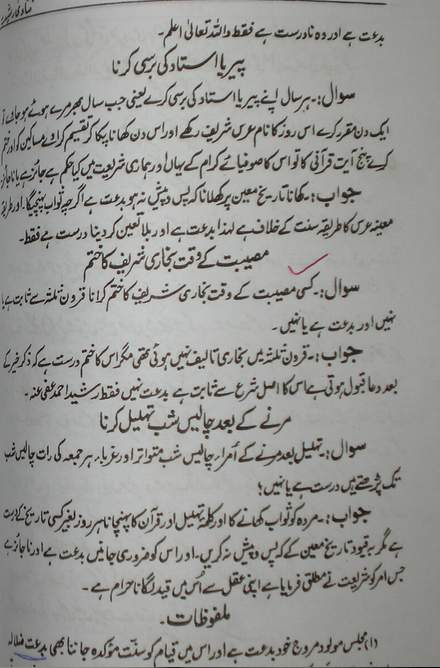
Completing Bukhari sharif at the time of Hardship
Question: Completing (the recitation of) Bukhari sharif ,at the time of hardship ,is Biddah or not? Do we have any proof from the scholars of first three centuries? (Salaf as saliheen)
Answer (By Mawlana Rashid Ahmed Gangohi)
Bukahri (sharif) was not compiled during the first three centuries but its completion (reading it from beginning to end) at times of hardship is a good act , as dua is accepted after dhikr. The basis for this act is established from shariah and it is not a biddah.
Thums Up to Deobandis!
This act was started by Deoband to make money. Everyone knows general population cannot recite Bukahri. So the person who has some problem he has to go to a group of Deobandi scholars and they all will distribute the chapters among themself and will read it , till it is completed. I am unaware whether Deobandis have kept this Sunnah of Mawlana Rashid Ahmed alive or not.
Now the other side of the coin.
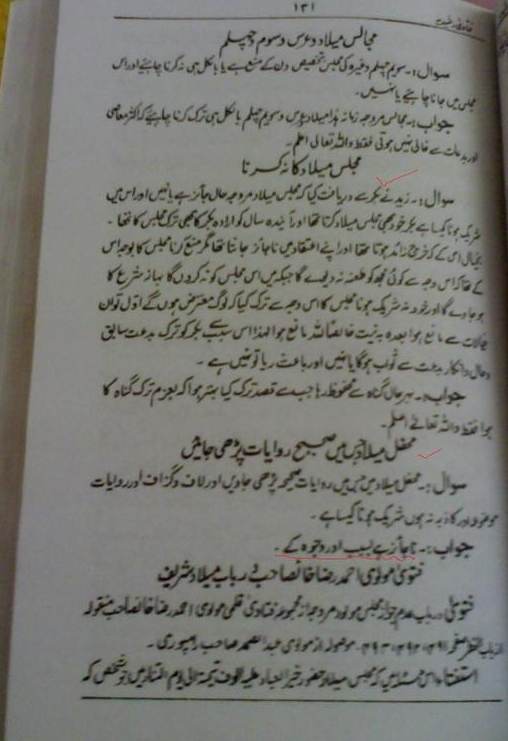
Question: Is it permissible to join those Mawlid gathering in which only correct narrations and incidence are read out?
Answer :(By Mawlana Rashid Ahmed Gangohi)
It is not permissible (Na jayaz) due to other reasons.
What Deobandis do is permissible, though it cannot be proved from any where. But what Sunnis do is not allowed, just because sunnis do it.
Analysis on visiting the Grave of Prophet صلی اللہ علیہ وسلم
Ahmed
Every believer has a desire to visit the Blessed Grave of Prophet(صلى الله عليه وسلم) during his life time. Some even spend their entire earning just to have a glimpse of it. But unfortunately some people from the minority sect have started corrupting the innocent minds of muslim ummah and thereby misleading them with false information. These extremist declare the act of visiting the Blessed Grave of Prophet(صلى الله عليه وسلم) as Biddah(Innovation) and Haram as was propagated by Ibn Taymiyyah whose verdict Imam Ibn Hajr al Asqalani rehmatullah alaih rightly called as: "ONE OF THE MOST UGLY THINGS REPORTED FROM IBN TAYMIYYAH"
(ألزموا ابن تيمية بتحريم شد الرحل إلى زيارة قبر سيدنا رسول الله صلى الله عليه وسلّم وأنكرنا صورة ذلك، وفي شرح ذلك من الطرفين طول، وهي من أبشع المسائل المنقولة عن ابن تيمية)
[Fath ul Bari, Sharh Sahih ul Bukhari (3/386)] This will be shown later on in this article. Now let us analyze the hadiths on this issue.
Hadith # 1
ثنا القاضي المحاملي نا عبيد الله ابن محمد الوراق نا موسى ابن هلال العبدي عن عبيد الله ابن عمر عن نافع ، عن ابن عمر قال
: قال رسول الله صلى الله عليه وسلم: من زار قبري وجبت له شفاعتي
Translation: Narrated by Ibn Umar (ra) that the Prophet (Peace be upon him) said: Whosoever visits my grave then my intercession becomes Wajib for him [Sunnan al-Daraqutni Volume No. 2, Page No. 244, Imam al-Bayhaqi in Shu‘ab al-Iman (3/490) and others]
ثنا القاضي المحاملي نا عبيد الله ابن محمد الوراق نا موسى ابن هلال العبدي عن عبيد الله ابن عمر عن نافع ، عن ابن عمر قال
: قال رسول الله صلى الله عليه وسلم: من زار قبري وجبت له شفاعتي
Translation: Narrated by Ibn Umar (ra) that the Prophet (Peace be upon him) said: Whosoever visits my grave then my intercession becomes Wajib for him [Sunnan al-Daraqutni Volume No. 2, Page No. 244, Imam al-Bayhaqi in Shu‘ab al-Iman (3/490) and others]
In this hadith Jirah [criticism] is done on 2 narrators
1) Musa bin Hilal
1) Musa bin Hilal
2) Ubayd Ullah ibn Umar
Although there is Tadil [authentication] on both these narrators too (remember there has been Jirah even upon Imam Bukhari and Imam Abu Hanifa, therefore had Jirah superseded Tadil then all Imams would become Liars), First of all we can prove the hadith to be Sahih but still If people with Bughz (hatred) for Prophet (Peace be upon him) do not believe then we can present ahadith in which these two narrators are not present (remember these narrators are not Fabricators, the maximum jirah upon them is of weakness, hence Ibn Taymiyyah made a blunder to call all these ahadith as Mawdo)
1) Regarding Musa bin Hilaal, Imam Ibn Hajr al-Asqalani (rah) while doing Tadil on him said:
وقال ابن عدي: أرجو أنه لا بأس به. قلت: وهو (صالح) الحديث، روى عنه أحمد، والفَضْلُ بن سَهْلٍ
Translation:Ibn Adi (rah) said: There is no harm in him and he said he is “SALIH UL HADITH” i.e. his ahadith are passable. From him have narrated Imam Ahmed and Fudhayl bin Sahl [Lisan ul Mizan, Volume No. 8, Page No. 157]
وقال ابن عدي: أرجو أنه لا بأس به. قلت: وهو (صالح) الحديث، روى عنه أحمد، والفَضْلُ بن سَهْلٍ
Translation:Ibn Adi (rah) said: There is no harm in him and he said he is “SALIH UL HADITH” i.e. his ahadith are passable. From him have narrated Imam Ahmed and Fudhayl bin Sahl [Lisan ul Mizan, Volume No. 8, Page No. 157]
2) Regarding Ubayd Ullah Ibn Umar (ra) Sheikh ul Islam Imam Taqi ud din Subki (rah) said:
Imam Abu Hatim said that he saw Imam Ahmed praising him a lot. And Yahya bin Ma’een said: There is no harm in him and his ahadith are written. Ibn Adi said: There is no harm in him and he “Truthful” [Shifa us Siqaam fi Ziyaratal Khayr al Anaam, Page No.9]
Imam Abu Hatim said that he saw Imam Ahmed praising him a lot. And Yahya bin Ma’een said: There is no harm in him and his ahadith are written. Ibn Adi said: There is no harm in him and he “Truthful” [Shifa us Siqaam fi Ziyaratal Khayr al Anaam, Page No.9]
A) Qadhi Shawkani said:
وقد صحح هذا الحديث ابن السكن وعبد الحق وتقي الدين السبكي
Translation: This hadith is declared “Sahih” by Ibn al-Sakin (rah), Abdul Haq (rah) and Taqi ud din as-Subki (rah) [Nayl al Awtar 5:164]
B) Imam Ibn Hajr al Asqalani (rah) also showed this authentication in his Talkhis al Habir (2:265)
C) Imam Sakhawi (rah) also declared it Sahih in al-Qawl al-Badi‘ (p. 160)
He also said:
قال الذهبي طرقه كلها لينة لكن يتقوى بعضها ببعض لأن ما في روايتها متهم بالكذب
Translation: Imam Dhahabi said: the chains of the hadith of visitation are all ‘soft’ (layyina) but strengthen each other because none of them contains any liar [Imam Sakhawi in al-Maqasid al Hasana, Volume No.1, Page No. 472]
قال الذهبي طرقه كلها لينة لكن يتقوى بعضها ببعض لأن ما في روايتها متهم بالكذب
Translation: Imam Dhahabi said: the chains of the hadith of visitation are all ‘soft’ (layyina) but strengthen each other because none of them contains any liar [Imam Sakhawi in al-Maqasid al Hasana, Volume No.1, Page No. 472]
Hadith # 2
حدثنا عبد الله ابن محمد ابن عبد العزيز نا أبو الربيع الزهراني نا حفص ابن أبي داود ، عن ليث ابن أبي سليم عن مجاهد عن ابن عمر قال
: قال رسول الله صلى الله عليه وسلم: من حج فزار قبري بعد وفاتي فكأنما زارني في حياتي
Narrated Abdullah Ibn Umar:
Allah's Messenger (صلى الله عليه وسلم) said: Whoever visits my grave after my death it is same as him visiting me in my life [Imam Tabrani in his Al-Kabir Volume No. 12, Page No. 291. Imam Bayhaqi in Sha’yb ul Iman Volume No. 3: Hadith #489]
Note: This hadith is also narrated by Ibn Umar (ra) but the chain of narrators in this case are totally different hence the hadith becomes Hassan
حدثنا عبد الله ابن محمد ابن عبد العزيز نا أبو الربيع الزهراني نا حفص ابن أبي داود ، عن ليث ابن أبي سليم عن مجاهد عن ابن عمر قال
: قال رسول الله صلى الله عليه وسلم: من حج فزار قبري بعد وفاتي فكأنما زارني في حياتي
Narrated Abdullah Ibn Umar:
Allah's Messenger (صلى الله عليه وسلم) said: Whoever visits my grave after my death it is same as him visiting me in my life [Imam Tabrani in his Al-Kabir Volume No. 12, Page No. 291. Imam Bayhaqi in Sha’yb ul Iman Volume No. 3: Hadith #489]
Note: This hadith is also narrated by Ibn Umar (ra) but the chain of narrators in this case are totally different hence the hadith becomes Hassan
A) Imam Ibn Qudama (rah) said:
ويستحب زيارة قبر النبي لما روى الدارقطني بإسناده عن ابن عمر قال: قال رسول الله : «من حج فزار قبري بعد وفاتي فكأنما زارني في حياتي» وفي رواية، «من زار قبري وجبت له شفاعتي
It is recommended to do Ziyarah of Prophet’s grave as it is narrated by Daraqutni with his Isnaad from Ibn Umar (ra) that the Prophet (Peace be upon him) said: Whosoever performs the Hajj after my death then he should visit my grave because It is as If he has visited me during my life. And he also narrated (another hadith) that Whosoever visits my grave then my intercession becomes Wajib for him [Imam Ibn Qudama in al-Mughni, Volume No. 5, Page No. 381]
ويستحب زيارة قبر النبي لما روى الدارقطني بإسناده عن ابن عمر قال: قال رسول الله : «من حج فزار قبري بعد وفاتي فكأنما زارني في حياتي» وفي رواية، «من زار قبري وجبت له شفاعتي
It is recommended to do Ziyarah of Prophet’s grave as it is narrated by Daraqutni with his Isnaad from Ibn Umar (ra) that the Prophet (Peace be upon him) said: Whosoever performs the Hajj after my death then he should visit my grave because It is as If he has visited me during my life. And he also narrated (another hadith) that Whosoever visits my grave then my intercession becomes Wajib for him [Imam Ibn Qudama in al-Mughni, Volume No. 5, Page No. 381]
B) Imam al Bahuti al-Hanbli (rah) has also said this in his Al-Kashaf al-Qanna [Volume No. 2, Page No. 290]
C) Qadhi Iyaad (rah) said in his magnificent Ash-Shifa
في حكم زيارة قبره صلى الله عليه وسلم، وفضيلة من زاره وسلم عليه
و زيارة قبره صلى الله عليه وسلم سنة من سنن المسلمين مجمع عليها، وفضيلة مرغب فيها: روى عن ابن عمر
Chapter: The order of visiting the grave of Prophet (Peace be upon him) and the Virtue of the one visiting it and sending Salam.
It should be known that visiting the grave of Prophet (Peace be upon him) is “Masnoon” for all Muslims and they have “IJMA” over it, It has such a virtue that It has been prescribed to us as it comes in the hadith of Ibn Umar (ra) [i.e. whosoever visits my grave then my intercession becomes Wajib for him] [Qadhi Iyaad in Ash-Shifa, Volume No.2, Page No. 53]
في حكم زيارة قبره صلى الله عليه وسلم، وفضيلة من زاره وسلم عليه
و زيارة قبره صلى الله عليه وسلم سنة من سنن المسلمين مجمع عليها، وفضيلة مرغب فيها: روى عن ابن عمر
Chapter: The order of visiting the grave of Prophet (Peace be upon him) and the Virtue of the one visiting it and sending Salam.
It should be known that visiting the grave of Prophet (Peace be upon him) is “Masnoon” for all Muslims and they have “IJMA” over it, It has such a virtue that It has been prescribed to us as it comes in the hadith of Ibn Umar (ra) [i.e. whosoever visits my grave then my intercession becomes Wajib for him] [Qadhi Iyaad in Ash-Shifa, Volume No.2, Page No. 53]
Hadith # 3
حدثنا عبدان بن احمد، قال: حدثنا عبد الله بن محمد العبادى البصري، قال: حدثنا مسلمة بن سالم الجهنى قال حدثنى عبيد الله بن عمر عن نافع عن سالم عن بن عمر قال
قال رسول الله صلى الله عليه وسلم من جاءني زائرا لا تعمله حاجة إلا زيارتى كان حقا على أن اكون له شفيعا يوم القيامة
Translation: Ibn Umar (ra) narrates that the Prophet (Peace be upon him) said: Anyone who comes to visit me and he came solely for this purpose then It becomes Wajib upon me to do intercession for him on the Day of Judgment [Imam Tabrani in Mu’ajm al Kabir, Volume No. 12, Page No. 291 and as mentioned in Al-Talkhis al Habir by al-Asqalani 2:241]
Note: The chain of this hadith is totally different from the first two which were mentioned therefore due to overwhelming different Turuq the hadith definitely becomes Hassan if not Sahih
حدثنا عبدان بن احمد، قال: حدثنا عبد الله بن محمد العبادى البصري، قال: حدثنا مسلمة بن سالم الجهنى قال حدثنى عبيد الله بن عمر عن نافع عن سالم عن بن عمر قال
قال رسول الله صلى الله عليه وسلم من جاءني زائرا لا تعمله حاجة إلا زيارتى كان حقا على أن اكون له شفيعا يوم القيامة
Translation: Ibn Umar (ra) narrates that the Prophet (Peace be upon him) said: Anyone who comes to visit me and he came solely for this purpose then It becomes Wajib upon me to do intercession for him on the Day of Judgment [Imam Tabrani in Mu’ajm al Kabir, Volume No. 12, Page No. 291 and as mentioned in Al-Talkhis al Habir by al-Asqalani 2:241]
Note: The chain of this hadith is totally different from the first two which were mentioned therefore due to overwhelming different Turuq the hadith definitely becomes Hassan if not Sahih
Hadith # 4
من حج البيت، ولم يزرني فقد جفاني رواه ابن عدي بسند حسن
Translation: The Prophet (Peace be upon him) said: Whosoever does Hajj of Bayt Ullah but does not visit me then He has been rude to me – Ibn Adi has narrated it with “Hassan” Chain [Hashiya Tahtawi, Volume No. 1, Page No. 403]
This hadith also has a different chain. It can be shown with 5 more ahadith with different chains plus the 2 outstanding Imams i.e. Sheikh ul Islam Taqi ud din as-Subki (rah) in his magnificent Shifa us Siqaam fi Ziyaratil Khayr al Anaam, and Imam al-Faqih Ibn Hajr al Haythami (rah) in Al-Jawhar al Munazzam have written their whole works on these ahadith and established all rulings in regards to visiting the blessed grave of Prophet (Peace be upon him) including detailed verdict of Tawassul and Istighatha through him to be fair. Hence these ahadith combined together reach the status of Hassan at least if not Sahih and this is accepted Usool in hadith methodology that ahadith coming from different ways become Hassan even if their chains are weak.
من حج البيت، ولم يزرني فقد جفاني رواه ابن عدي بسند حسن
Translation: The Prophet (Peace be upon him) said: Whosoever does Hajj of Bayt Ullah but does not visit me then He has been rude to me – Ibn Adi has narrated it with “Hassan” Chain [Hashiya Tahtawi, Volume No. 1, Page No. 403]
This hadith also has a different chain. It can be shown with 5 more ahadith with different chains plus the 2 outstanding Imams i.e. Sheikh ul Islam Taqi ud din as-Subki (rah) in his magnificent Shifa us Siqaam fi Ziyaratil Khayr al Anaam, and Imam al-Faqih Ibn Hajr al Haythami (rah) in Al-Jawhar al Munazzam have written their whole works on these ahadith and established all rulings in regards to visiting the blessed grave of Prophet (Peace be upon him) including detailed verdict of Tawassul and Istighatha through him to be fair. Hence these ahadith combined together reach the status of Hassan at least if not Sahih and this is accepted Usool in hadith methodology that ahadith coming from different ways become Hassan even if their chains are weak.
View of Modern Day Scholars Vs Classical Scholars
Modern Day Scholar: The famous Wahabite modern day scholar i.e Nasiruddin Albani was known for his Bughz for the blessed grave of Prophet (Peace be upon him), but he went few steps ahead and even declared sahih ahadith about praying 40 prayers in Masjid an-Nabwi as Da'eef and the practise as Bidah (Audhobillah Min Dhalik), he said in his book Hujjat al-Nabi [Page: 185]: It is an innovation (bid’ah) to visit Madeenah and tell the visitors to Madeenah to stay there for a week so that they will be able to offer forty prayers in the Prophet’s Mosque so that they will be free from hypocrisy and saved from the Fire.”
Actually the hadith of 40 prayers in Masjid an-Nabwi is authentic and it is Dajl/lie of Albani to call it weak. None of the classical Muhaditheen called this report as weak rather they called it "SAHIH/HASAN"
عن أنس بن مالك ، عن النبي صلى الله عليه وسلّم قال: «مَنْ صَلَّى في مَسْجِدِي أَرْبَعينَ صَلاةً لا تَفُوْتُهُ صَلاةٌ كَتَبَ له بَرَاءَةً مِنَ النَّارِ وَبَرَاءَةً مِنَ العَذَابِ، وَبَرِىءَ مِنَ النِّفَاقِ».
قلت: روى الترمذي بعضه.
رواه أحمد والطبراني في الأوسط ورجاله ثقات.
Translation: Narrated by Anas bin Malik (ra) that the Prophet (Peace be upon him) said: Anyone who prays 40 prayers in my Mosque without missing a single one, then for him is freedom from hell fire, freedom from torment and freedom from Nifaaq
Imam al-Haythami said: Some part of it is narrated in Tirmidhi. This one is narrated by Imam Ahmed, Tabarani in his al-Awsat and the Rijaal of it are “(ALL) THIQA” [Majma az-Zawaid 3/667, Hadith # 5878]
Imam al-Mundhiri (rah) said in his Targheeb wa Tarheeb:
رواه أحمد، ورواته رواة الصحيح،
Translation: It is narrated by Ahmed and It is amongst Sahih narrations [Targheeb wa Tarheeb 2/139]
So Ummah is told to beware of Salafi Dajl in this regard.
Another Modern Day Scholar i.e. Abdullah bin Baaz said: It is not obligatory for the pilgrims, men or women,to visit the grave of the Messenger (peace and blessings of Allaah be upon him) or al-Baqee’, rather it is haraam to travel with the purpose of visiting graves in general..[Standing Committee for Academic Research and Issuing Fatwas: Shaykh ‘Abd al-‘Azeez ibn ‘Abd-Allaah ibn Baaz, Shaykh ‘Abd al-Razzaaq ‘Afeefi, Shaykh ‘Abd-Allaah ibn Ghadyaan. Fataawa al-Lajnah al-Daa’imah li’l-Buhooth al-‘Ilmiyyah wa’l-Ifta (11/362)
VS
Classical Scholar: Sheikh ul-Islam al-Hafiz al-Imam Nawawi(Rehmatuallah aliye)
In his Kitab ul Adhkaar:
اعلم أنه ينبغي لكل من حجّ أن يتوجه إلى زيارة رسول اللّه صلى اللّه عليه وسلم، سواء كان ذلك طريقه أو لم يكن، فإن زيارته صلى اللّه عليه وسلم من أهمّ القربات وأربح المساعي وأفضل الطلبات، فإذا توجَّه للزيارة أكثرَ من الصلاة عليه صلى اللّه عليه وسلم في طريقه، فإذا وقعَ بصرُه على أشجار المدينة وحَرمِها وما يَعرفُ بها زاد من الصلاة والتسليم عليه صلى اللّه عليه وسلم، وسألَ اللّه تعالى أن ينفعَه بزيارته صلى اللّه عليه وسلم، وأن يُسعدَه بها في الدارين، وليقلْ: اللَّهُمَّ افْتَحْ عَليَّ أبْوَابَ رَحْمَتِكَ وَارْزُقْنِي في زِيارَةِ قَبْرِ نَبِيِّكَ صلى اللّه عليه وسلم ما رزقْتَهُ أوْلِياءَكَ وأهْلَ طَاعَتِكَ واغْفِرْ لي وارْحمنِي يا خَيْرَ مَسْؤُول
Section: Chapter regarding Visit to the Tomb of the Messenger of Allah (Salallaho alaihi wasalam), and the Dhikr made there"In his Kitab ul Adhkaar:
اعلم أنه ينبغي لكل من حجّ أن يتوجه إلى زيارة رسول اللّه صلى اللّه عليه وسلم، سواء كان ذلك طريقه أو لم يكن، فإن زيارته صلى اللّه عليه وسلم من أهمّ القربات وأربح المساعي وأفضل الطلبات، فإذا توجَّه للزيارة أكثرَ من الصلاة عليه صلى اللّه عليه وسلم في طريقه، فإذا وقعَ بصرُه على أشجار المدينة وحَرمِها وما يَعرفُ بها زاد من الصلاة والتسليم عليه صلى اللّه عليه وسلم، وسألَ اللّه تعالى أن ينفعَه بزيارته صلى اللّه عليه وسلم، وأن يُسعدَه بها في الدارين، وليقلْ: اللَّهُمَّ افْتَحْ عَليَّ أبْوَابَ رَحْمَتِكَ وَارْزُقْنِي في زِيارَةِ قَبْرِ نَبِيِّكَ صلى اللّه عليه وسلم ما رزقْتَهُ أوْلِياءَكَ وأهْلَ طَاعَتِكَ واغْفِرْ لي وارْحمنِي يا خَيْرَ مَسْؤُول
It should be known that “EVERYONE” who performs the hajj should set out to visit the Messenger of Allah (Salallaho alaihi wasalam), “WHETHER IT IS ON ONE’S WAY OR NOT” because visiting him (Salallaho alaihi wasalam) is one of the most important acts of worship, the most rewarded of efforts, and best of goals. When one sets out to perform the visit, one should do much of the blessings and peace upon him (salallaho alaihi wasalam) on the way. And when one’s eye falls on the trees of Medina, and its sanctum and landmarks, one should increase sending the blessings and peace upon the Prophet (Allah bless him and give him peace), asking Allah Most High to benefit one by one’s “VISIT TO HIM” (Allah bless him and give him peace)...and grant one felicity in this world and the next through it. One should say,"O Allah, open for me the doors of Your mercy, and bestow upon me, through the visit to the Grave of Your prophet (Allah bless him and give him peace), that which You have bestowed upon Your friends, those who obey You. Forgive me and show me mercy, O Best of Those Asked" (Imam Nawawi in Kitab ul Adhkaar, Page No. 178)
Scanned Page :-
Imam Nawawi (Rehmatuallah alihe)
Kitab ul Adhkaar by Imam Nawawi (Rahimuhullah) - Published by Dar ul Marifah, Beirut, Lebanon
Kitab ul Adhkaar by Imam Nawawi (Rahimuhullah) - Published by Dar ul Marifah, Beirut, Lebanon

Page No. 178

[CLICK ON THE IMAGE TO ENLARGE]
Important Note: This passage has been deliberately forged by Salafis in the edition of Salafi scholar Abdul Qadir al Ar'anoot, they changed the wording "QABR" into "MASJID" and also removed the passage which proved Tawassul through the Dhaat of Prophet صلی اللہ علیہ وسلم ... Audhobillah Min Dhalik. This exposition of Salafis is more than enough to establish that they keep Bughz for the Prophet صلی اللہ علیہ وسلم


